H2H Marketing: 10 Ways to Make B2B Feel Human

H2H marketing for manufacturers writes to one human, the operator or owner on the floor, instead of a faceless "manufacturer audience" that doesn't exist. It isn't soft. The pattern is clear: buyers spend more time with content that sounds like one operator talking to another than with polished corporate copy.
What that looks like in practice:
- Write to one person, named and specific
- The payoff: more time on content, and more inbound
- The voice: how an operator explains it to another operator
This post is the H2H playbook. For the broader paid-media context, see the Google and Meta ads for manufacturers hub.
If you want it built for your team, see our sales enablement services for manufacturers.
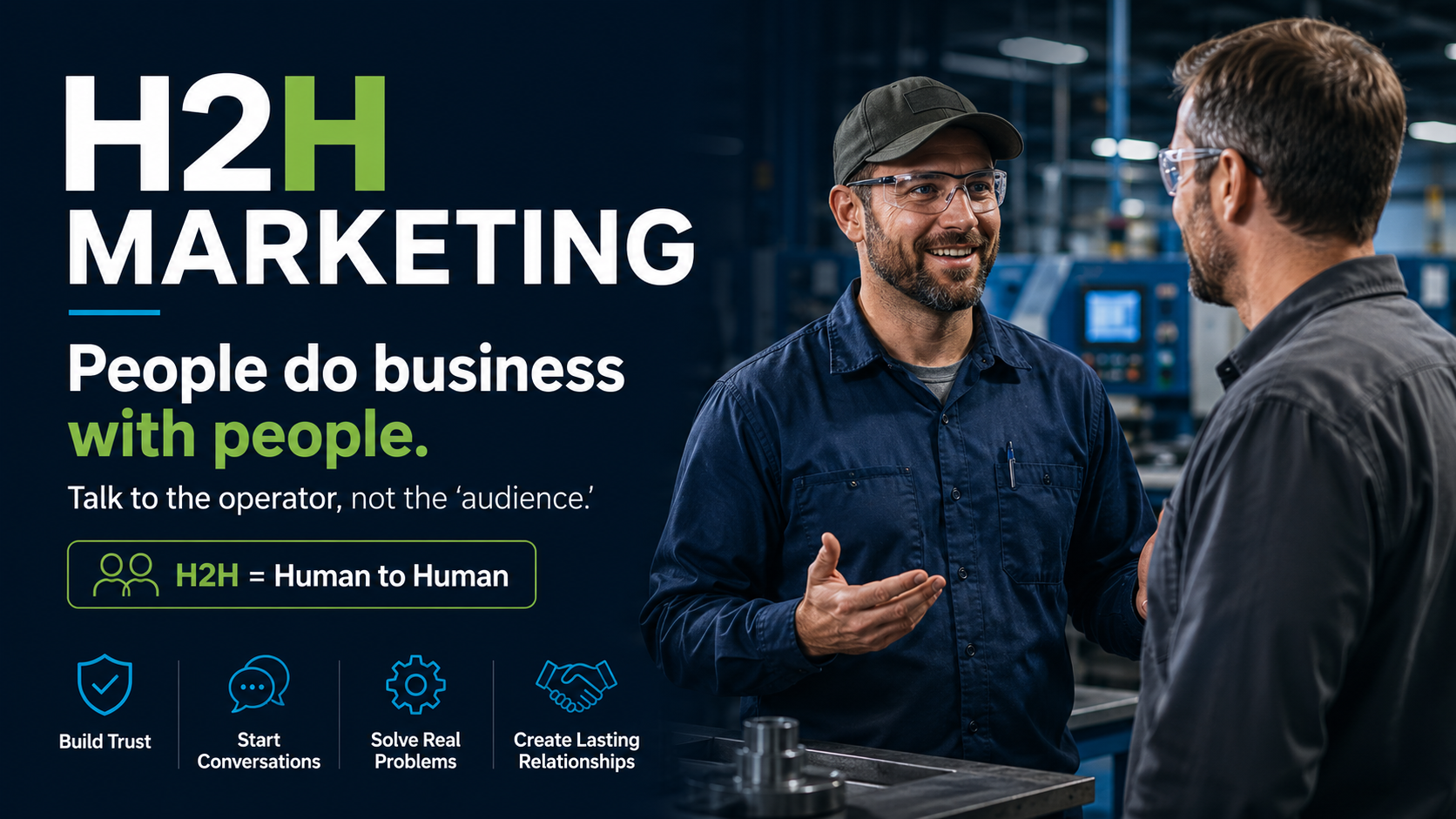
H2H marketing for manufacturers means writing to one real person: the owner, operator, engineer, plant manager, purchasing lead, dealer, or distributor. It does not mean writing to a vague “B2B audience” that does not actually exist.
This is not about making your marketing soft. It is about making technical, high-consideration buying decisions easier to understand, easier to trust, and easier to act on.
Most manufacturer sales do not happen in one click. They happen through calls, quote requests, distributor conversations, samples, specs, approvals, proposals, and follow-up. That means your marketing has one primary job: help the right buyer trust you enough to take the next step.
This post is the H2H playbook. For the broader paid-media context, see the Google and Meta ads for manufacturers hub.
What H2H Marketing Means for Manufacturers
H2H stands for human-to-human marketing.
For manufacturers, that means your message should sound like it was written for the person responsible for solving the problem, not for a committee, not for an algorithm, and not for a generic industry category.
A plant manager does not care that you are “innovative.” They care whether your product reduces downtime.
An engineer does not care that you are “customer-focused.” They care whether your solution fits the spec, performs under pressure, and avoids problems later.
A purchasing lead does not care that your company has “world-class service.” They care whether they can justify the decision, avoid risk, and get a clear answer when something goes wrong.
An owner does not care that you offer “quality solutions.” They care whether your company can help them grow, protect margin, reduce bottlenecks, or solve a painful operational issue.
H2H marketing translates your technical value into language the buyer can use to make a confident decision.
Why Manufacturer Marketing Often Feels Too Corporate
A lot of manufacturer marketing sounds interchangeable.
The language is usually polished, but vague:
- Industry-leading solutions
- High-quality products
- Trusted partner
- Innovative technology
- Superior customer service
- Built to last
- Engineered for performance
None of those phrases are necessarily wrong. The problem is that they are so common that they stop meaning anything.
Human marketing gets more specific.
Instead of saying:
“We provide high-quality industrial equipment.”
Say:
“We help production teams reduce downtime when aging equipment can no longer keep up with demand.”
Instead of saying:
“We offer custom solutions.”
Say:
“We help manufacturers that cannot use off-the-shelf equipment because their product, process, or space constraints require a custom build.”
Instead of saying:
“We are a trusted partner.”
Say:
“We help owners and plant managers avoid the risk of buying equipment that looks right on paper but fails in production.”
That is the difference. Corporate marketing talks about the company. H2H marketing talks about the buyer’s real problem.

10 Ways to Make B2B Manufacturer Marketing Feel More Human
1. Write to one specific buyer role
Do not write to “manufacturers.” Write to the person inside the company who feels the problem most directly.
That may be:
- The owner trying to scale production
- The engineer comparing technical options
- The plant manager dealing with downtime
- The purchasing lead trying to reduce vendor risk
- The distributor trying to recommend the right product
- The operator frustrated with an inefficient process
The more specific the reader, the more human the message becomes.
Weak:
“Our products help manufacturers improve efficiency.”
Stronger:
“If your production team is losing hours every week to rework, changeovers, or equipment limitations, the real cost is not just labor. It is lost capacity.”
That sounds like it was written for someone living with the problem.
2. Use the buyer’s actual language
Your customers probably do not describe their problem the way your marketing team does.
They may not say:
“We need a more scalable production solution.”
They may say:
“We are maxed out.”
“We cannot keep up with orders.”
“This machine is killing us.”
“We need something that does not break every time volume spikes.”
“Our team is wasting too much time babysitting the process.”
H2H marketing starts by listening to sales calls, quote requests, customer emails, reviews, distributor feedback, and support questions. Then it uses the buyer’s language in the content.
That does not mean your copy should be sloppy. It means it should sound like it came from the real world.
3. Lead with the operational problem
Most manufacturer content starts with the product.
H2H marketing starts with the problem.
Before you explain what your product does, explain the pain it solves:
- Downtime
- Waste
- Rework
- Missed production targets
- Long lead times
- Labor shortages
- Inconsistent quality
- Compliance pressure
- Capacity limits
- Dealer or distributor confusion
- Poor quote follow-up
- Bad marketing attribution
When the buyer sees their problem clearly stated, they are more likely to trust the rest of the message.
A good opening makes the buyer think:
“That is exactly what we are dealing with.”
4. Replace generic claims with practical proof
Manufacturers often make claims that sound impressive but do not prove much.
Examples:
- Best-in-class
- Industry-leading
- Unmatched quality
- Superior performance
- Reliable solutions
H2H marketing turns claims into proof.
Use:
- Before-and-after examples
- Specific applications
- Case studies
- Photos or videos from real use cases
- Quote-to-sale examples
- Production improvements
- Dealer success stories
- Customer objections and how they were solved
- Technical comparisons
- Installation or implementation details
Instead of saying:
“Our system improves efficiency.”
Say:
“One customer used the system to reduce manual handling between production steps, which allowed the same team to process more orders without adding another shift.”
That is more credible because it shows what changed.
5. Explain tradeoffs honestly
Buyers trust companies that explain both the upside and the limitations.
If your product is not the cheapest, say why.
If your process takes longer because it is custom, explain the reason.
If your solution is not right for every buyer, say who it is not for.
For example:
“This is not the right fit if you need the lowest-cost option available. It is built for manufacturers that need a more durable, application-specific solution and want to avoid replacing underbuilt equipment later.”
That kind of honesty feels human because it sounds like a real sales conversation. It also helps qualify the right buyers and repel the wrong ones.
6. Make technical content easier to understand
Human marketing does not mean dumbing down technical content. It means organizing it so the buyer can use it.
For manufacturers, technical content should answer questions like:
- What does this product do?
- What problem does it solve?
- What applications is it best for?
- What specs matter most?
- What options or configurations are available?
- What should buyers compare before choosing?
- What mistakes should they avoid?
- What happens after they request a quote?
Engineers and technical buyers still want detail. But they should not have to dig through vague copy, cluttered pages, or disconnected PDFs to find it.
Clear technical content builds confidence.
7. Show real people, real products, and real applications
Stock photos and generic product images can make a manufacturer look less credible.
H2H marketing works better when buyers can see the real world behind the company:
- Real equipment
- Real facilities
- Real team members
- Real installation examples
- Real applications
- Real customer environments
- Real before-and-after visuals
- Real sales or engineering expertise
This matters because manufacturing buyers are trying to reduce risk. They want to know that there are experienced people behind the website, not just polished marketing language.
8. Connect content to offline sales conversations
For most manufacturers, the website does not close the sale by itself.
The website starts or supports a sales conversation.
That means your content should help buyers take the next step:
- Request a quote
- Call sales
- Download a guide
- Compare options
- Send specs
- Ask about fit
- Share the page internally
- Prepare for a sales conversation
Good H2H content gives the buyer language they can use inside their own company.
For example:
- “Here is what to ask before replacing this equipment.”
- “Here is how to compare two vendors.”
- “Here is what affects lead time.”
- “Here is what drives cost.”
- “Here is what usually causes failure.”
- “Here is what to send us for an accurate quote.”
That is useful marketing because it helps the buyer move forward.
9. Follow up like a helpful expert, not an automation sequence
Automation can support H2H marketing, but it cannot replace it.
A bad follow-up sequence says:
“Just checking in.”
A better follow-up says:
“Based on what you were reviewing, here are three things to consider before choosing a system.”
Or:
“If you are comparing vendors, the biggest differences usually come down to material quality, customization, lead time, and support after installation.”
That kind of follow-up feels human because it helps the buyer make a better decision.
For manufacturers with long sales cycles, this matters. Buyers may not be ready today, but they remember who helped them think clearly.
10. Measure human engagement against real sales outcomes
H2H marketing still needs to be measurable.
The goal is not just more likes, impressions, or traffic. The goal is better conversations, better leads, better quotes, and better customers.
Track signals like:
- Qualified form submissions
- Quote requests
- Phone calls
- Sales conversations
- Sample requests
- Distributor inquiries
- Returning visitors
- Content-assisted conversions
- Closed deals connected to campaigns
- CRM movement after content engagement
Human marketing should still lead to measurable growth.
If a blog post, ad, video, or email helps a buyer understand the problem, trust the company, and take the next step, it is doing its job.
Where H2H Marketing Shows Up
H2H marketing is not limited to social media.
For manufacturers, it should show up across the entire buying journey:
Website copy
Your website should make it immediately clear who you help, what problem you solve, and why buyers should trust you.
Product and service pages
Product pages should explain applications, use cases, specs, tradeoffs, options, and next steps.
Paid ads
Ads should speak to a specific pain point, not just promote the company.
Video
Video should show real people, products, problems, and outcomes. A buyer should quickly understand why the message matters.
Email follow-up
Email should help the buyer move through the decision, not just remind them that your company exists.
Sales kits
Sales kits should give reps, dealers, and buyers the proof they need to move the conversation forward.
Case studies
Case studies should show the buyer’s problem, the decision process, the solution, and the measurable or practical result.
Social media
Social media can still be useful, but only when it supports the larger strategy. The point is not to post constantly. The point is to create useful, credible, human content that helps the right buyer trust your company.
How to Make Social Media More Human Without Making It Random
Social media should not replace your broader marketing strategy. It should support it.
For manufacturers, the strongest social content usually comes from real expertise:
- A product in use
- A technical tip
- A customer application
- A common buying mistake
- A short explanation from an expert
- A behind-the-scenes look at production
- A customer question answered clearly
- A comparison between options
- A problem your team solved
Before choosing platforms or posting schedules, answer the more important question:
What does our buyer need to understand before they trust us enough to take the next step?
Once that is clear, platform choices become easier.
LinkedIn may be useful for reaching executives, engineers, sales leaders, and distributors.
YouTube may be useful for product education, demonstrations, and technical explanations.
Meta may be useful for retargeting, recruiting, brand visibility, or visual storytelling.
But the platform is not the strategy. The message is.
The Bottom Line
H2H marketing for manufacturers is not about being casual, clever, or emotional for the sake of it.
It is about making complex buying decisions feel clearer, safer, and more trustworthy.
The buyer is not a company. The buyer is a person with a problem, a deadline, a budget, a boss, a team, and a risk they are trying to avoid.
When your marketing speaks to that person directly, your content becomes more useful, your ads become more relevant, your sales conversations become stronger, and your follow-up becomes more effective.
Human connection should lead to measurable growth.

Related Resources
Learn More About the Future of Digital Marketing
The future belongs to those who build it. Discover how to engineer marketing systems that perform as precisely as your production line.