Backlink Building Without Begging: Earning Real Authority

The link-buying tricks that worked in 2014 now drag rankings down, and Google can tell the difference. Backlink building for B2B manufacturers means earning links from sources Google already trusts: trade publications, suppliers, customers, and industry associations. This post covers how to earn them without begging, buying, or trading.
This post is the operator playbook for the legitimate side of link earning. For the broader system, see the SEO for Manufacturers hub.
We handle this for clients through our SEO services for manufacturers.
Why most manufacturer link-building fails
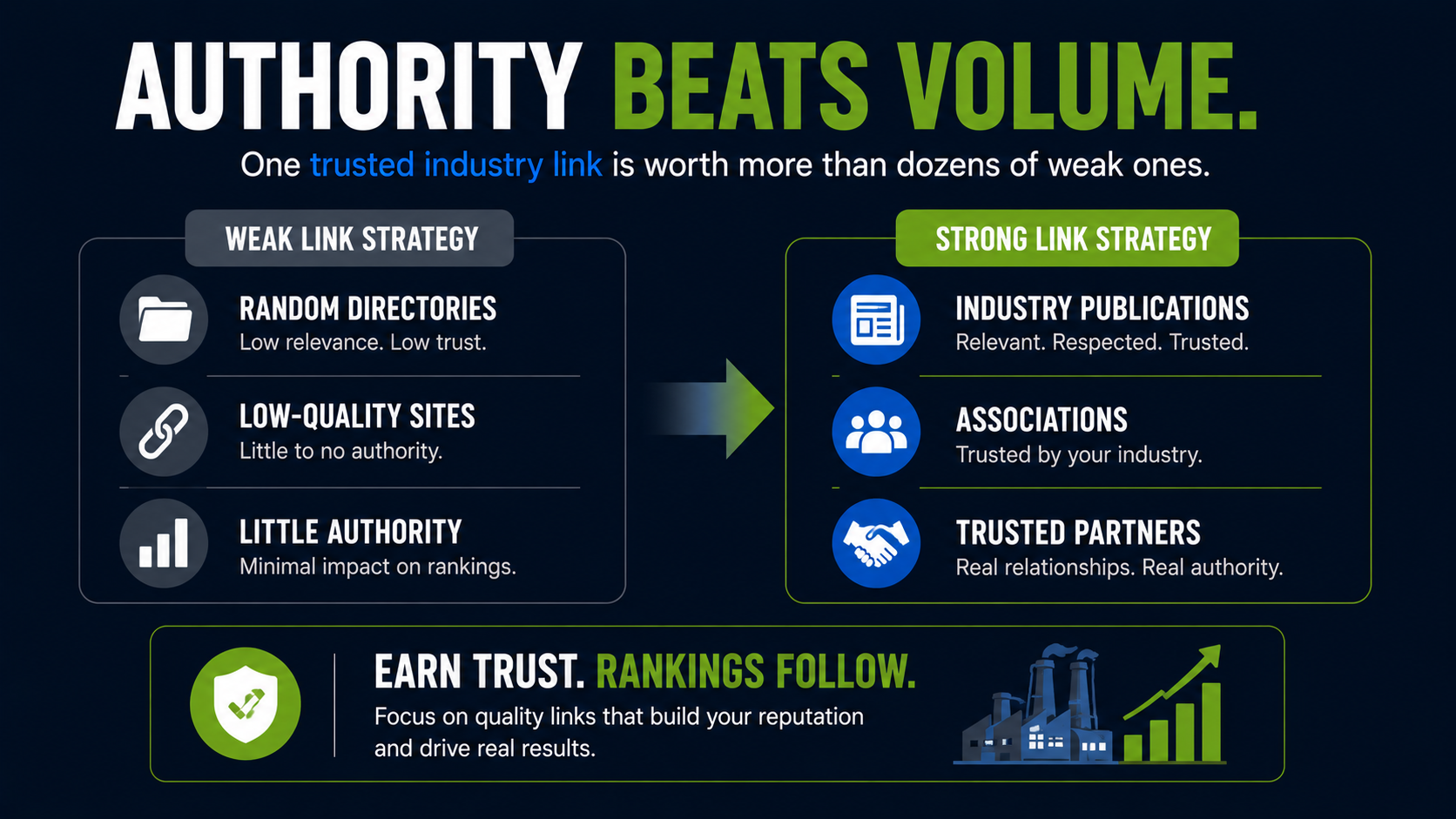
The default link-building strategy at most agencies is mass outreach: scrape lists of bloggers and webmasters, send templated email asking for links, often with a pitch about reciprocal exchange or guest-post placement. The conversion rates are abysmal (typically under 1%), the links acquired are usually low-authority, and the practice triggers Google's spam filters when scaled.
For manufacturers, this approach is doubly wrong: the time investment is large, the risk is real, and the manufacturer already has access to better link sources through real industry relationships. The trade publication that wrote about the manufacturer's last product launch is more valuable than 100 templated outreach links.
The 5 legitimate backlink sources for manufacturers
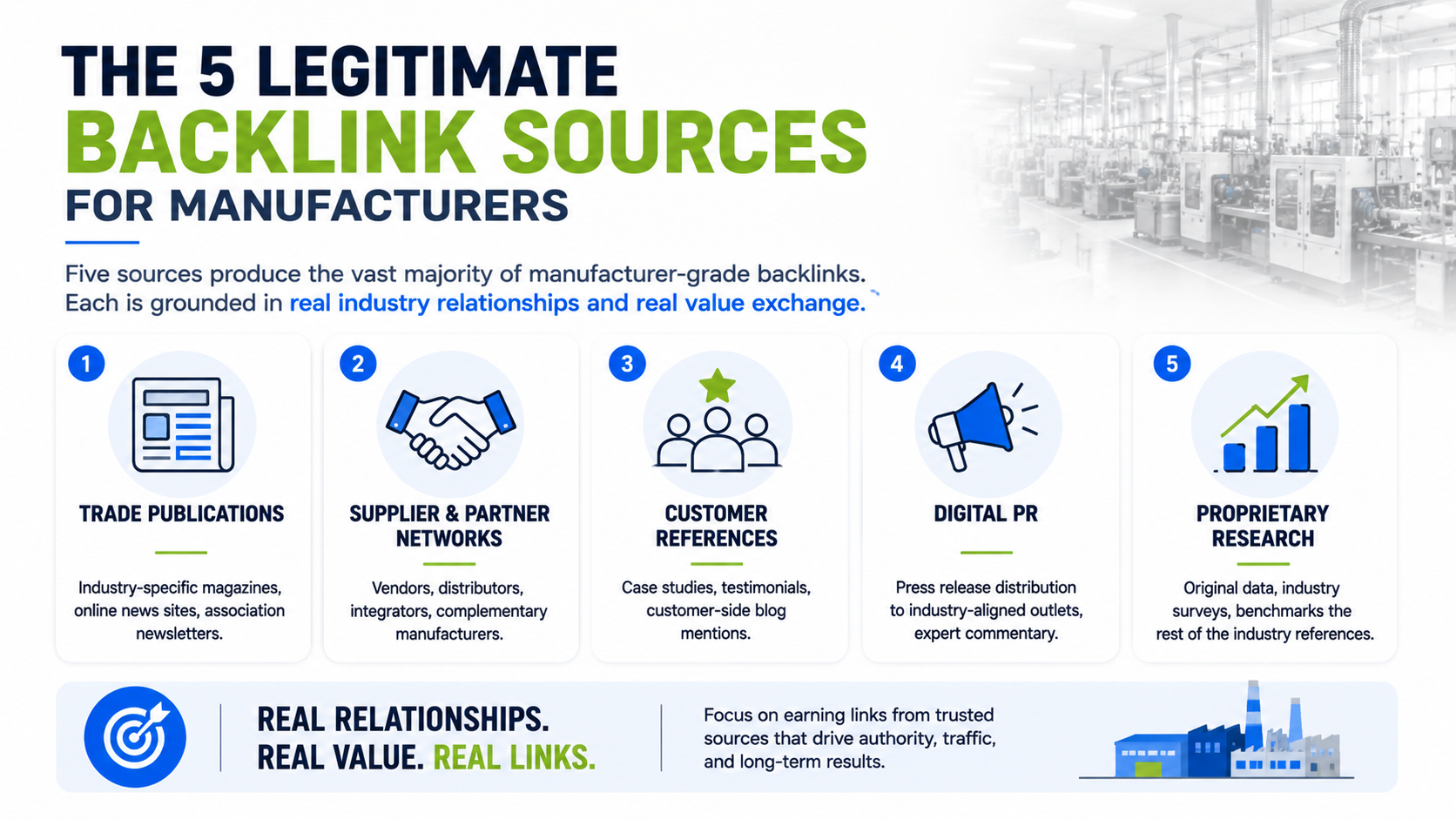
Five sources produce the vast majority of manufacturer-grade backlinks. Each is grounded in real industry relationships and real value exchange.
- Trade publications: industry-specific magazines, online news sites, association newsletters.
- Supplier and partner networks: vendors, distributors, integrators, complementary manufacturers.
- Customer references: case studies, testimonials, customer-side blog mentions.
- Digital PR: press release distribution to industry-aligned outlets, expert commentary.
- Proprietary research: original data, industry surveys, benchmarks the rest of the industry references.
Trade publication placements
Industry trade publications are the highest-leverage backlink source for most manufacturers. The publications target your exact buyer (high-authority signal), they accept submissions (open door), and they produce evergreen links (long compounding effect).
The pattern that works: identify the 5-10 trade publications your buyers actually read; subscribe; build relationships with the editors over 3-6 months by sharing genuinely useful operator commentary; offer pieces (product launches, application case studies, expert columns) that match the publication's editorial focus. Most trade publications publish quality contributed content because their editorial budgets are constrained. A well-prepared manufacturer can earn 4-8 trade-pub placements per year.
Supplier and partner network links
Every manufacturer has a network of suppliers, distributors, integrators, and partners who could plausibly link to the manufacturer's website but currently do not. The audit is simple: list every supplier and partner relationship; check whether they link to your site; if not, ask, with a specific suggestion of where the link fits naturally on their site.
The conversion rate on partner-link requests is high (often 40-60%) because the request matches the existing relationship. American Rotary's dealer network, for example, produces a steady stream of high-authority links because each dealer page links back to the manufacturer's main site for product specifications and warranty information.
Customer and case-study links
Customer-side links are some of the most valuable backlinks a manufacturer can earn because they pass authority and act as social proof. The pattern: produce a customer case study (with the customer's collaboration), publish it on the manufacturer's site, and ask the customer to link to it from their own 'in the news' or 'partners' page.
Customers usually agree because the case study reflects favorably on them too. The link is unique (no other manufacturer can claim that customer's relationship), high-authority (real businesses with established sites), and evergreen (the case study stays relevant for years). Precision Quincy's customer case studies produced a meaningful share of its overall backlink profile.
Digital PR for manufacturers
Digital PR is the systematic pursuit of media coverage in industry-aligned outlets. Unlike trade publication contributions (where you write the piece), digital PR is journalist-driven (the journalist writes, you provide the angle and quotes).
For manufacturers, digital PR works when the company has something genuinely newsworthy: a new product launch, a major customer win, an industry-relevant data finding, an expert position on an industry trend. Most manufacturers have several of these per year and never pitch them. A structured PR cadence (one pitchable angle per quarter) produces consistent backlink yield from outlets like IndustryWeek, Modern Manufacturing, ASSEMBLY Magazine, and category-specific publications.
Proprietary research as link bait
The single highest-leverage backlink-earning asset a manufacturer can produce is original research: a survey of the manufacturer's customer base on a specific industry topic, a benchmark study of operating metrics, a deep analysis of an industry trend backed by the manufacturer's own data.
Original research, when published with clean data and clear methodology, gets cited by other manufacturers, by trade publications, by industry analysts. Each citation is a backlink, and the citation chain compounds. A single well-executed research piece can produce 20-50 backlinks over its lifetime, vastly outperforming any other link-building method.
What to avoid
Three categories of link-building actively damage manufacturer SEO. Avoid each.
- Link exchanges: 'I'll link to you if you link to me' deals, especially when scaled across many partners.
- Paid links from low-authority sites: directories, link farms, sponsored-post networks not labeled as ads.
- Mass templated outreach: scraped-list email campaigns with generic pitches.
Each of these triggers Google's spam classifiers and either devalues the links or, in severe cases, manually penalizes the receiving site. The risk is real and asymmetric: a single penalty can erase years of SEO work. The legitimate methods above produce slower but durable results.
Frequently asked questions

How many backlinks does a manufacturer need?
Quality matters more than quantity. A mid-market manufacturer with 50-100 high-authority backlinks from relevant industry sources typically outranks a competitor with 1,000 low-authority links. The right benchmark is referring domains (unique sites linking to you), not raw link count.
How long until link-building shows up in rankings?
Trade-pub and customer-side links typically influence rankings within 30-90 days of acquisition. Cumulative ranking lift from a sustained link-earning program (4-8 quality links per quarter) typically appears 6-12 months in. Original research can produce ranking lift faster because the citations cluster on the same publication.
Can manufacturers run link-building without a dedicated PR team?
Yes, with discipline. The trade-publication and customer-link methods are within reach of a marketing team of 1-2 people if treated as a structured quarterly process. Digital PR and proprietary research benefit from outside help.
The decision is usually impact-vs-cost.

Related Resources
Learn More About the Future of Digital Marketing
The future belongs to those who build it. Discover how to engineer marketing systems that perform as precisely as your production line.