SEO for Manufacturers: The 2026 Operator Playbook

SEO for manufacturers is earning organic visibility from buyers using Google, Bing, and AI engines to find vendors. For most industrial firms and smaller shops, it's one of the only channels that compounds instead of resetting monthly. Since 2024 it's split in two: classic ranking signals for Google, and the GEO discipline for AI search.
Plus with great content you can boost your social and email results.
Two disciplines now, not one:
- The channel that compounds, unlike paid where results disappear when you stop spending
- Classic SEO: technical, on-page, links for Google
- GEO: structured content built for AI search
This hub covers the classic side. The Peak 10 AI Search Visibility hub covers the AI side. Together they form a complete operator playbook for organic visibility in 2026.
The 6 components of manufacturer SEO
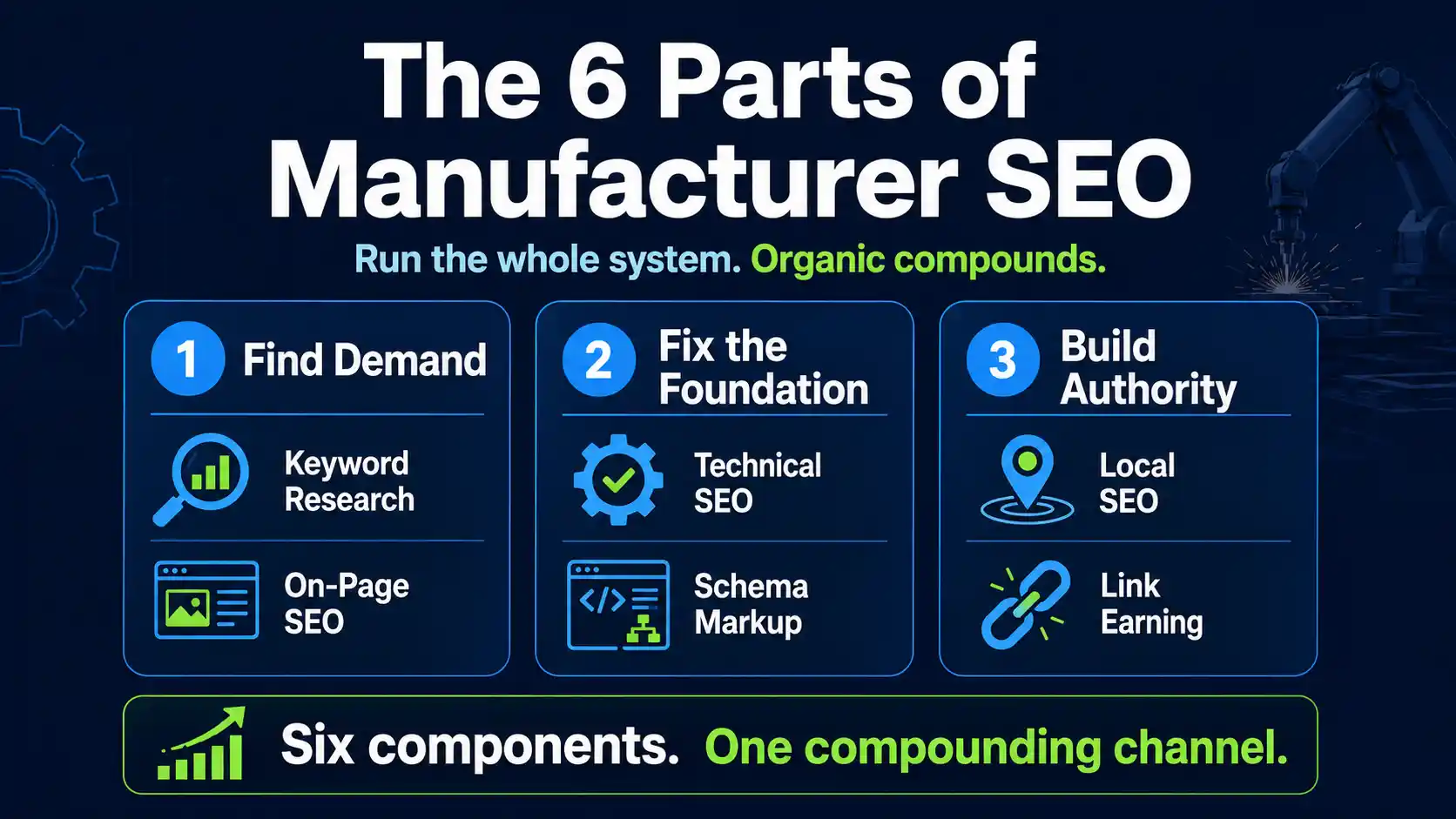
Modern SEO for a mid-market manufacturer breaks into six components, each addressed by a dedicated post in this hub. Run all six and the organic channel compounds. Run two or three and the work mostly stalls.
- Keyword research grounded in closed-deal data, not search-volume defaults.
- Technical SEO: site speed, crawlability, mobile, structured data.
- On-page SEO: title tags, headings, body content, internal linking on product and application pages.
- schema markup: Product, Article, FAQ, Organization, How-To.
- Local SEO: for multi-location manufacturers and dealer networks.
- Link earning: trade publications, supplier networks, customer references, digital PR.
A 90-day SEO audit identifies where each component is healthy, where it is broken, and what to fix first. Most manufacturers we audit pass two or three components and fail the rest, which is why organic share of pipeline plateaus regardless of how much new content gets published.
Why SEO still matters in the AI era
AI search is rising. Traditional search has not disappeared. As of 2026, Google still handles roughly 90% of global search (Statcounter), and the majority of high-intent buyer queries still run through it.
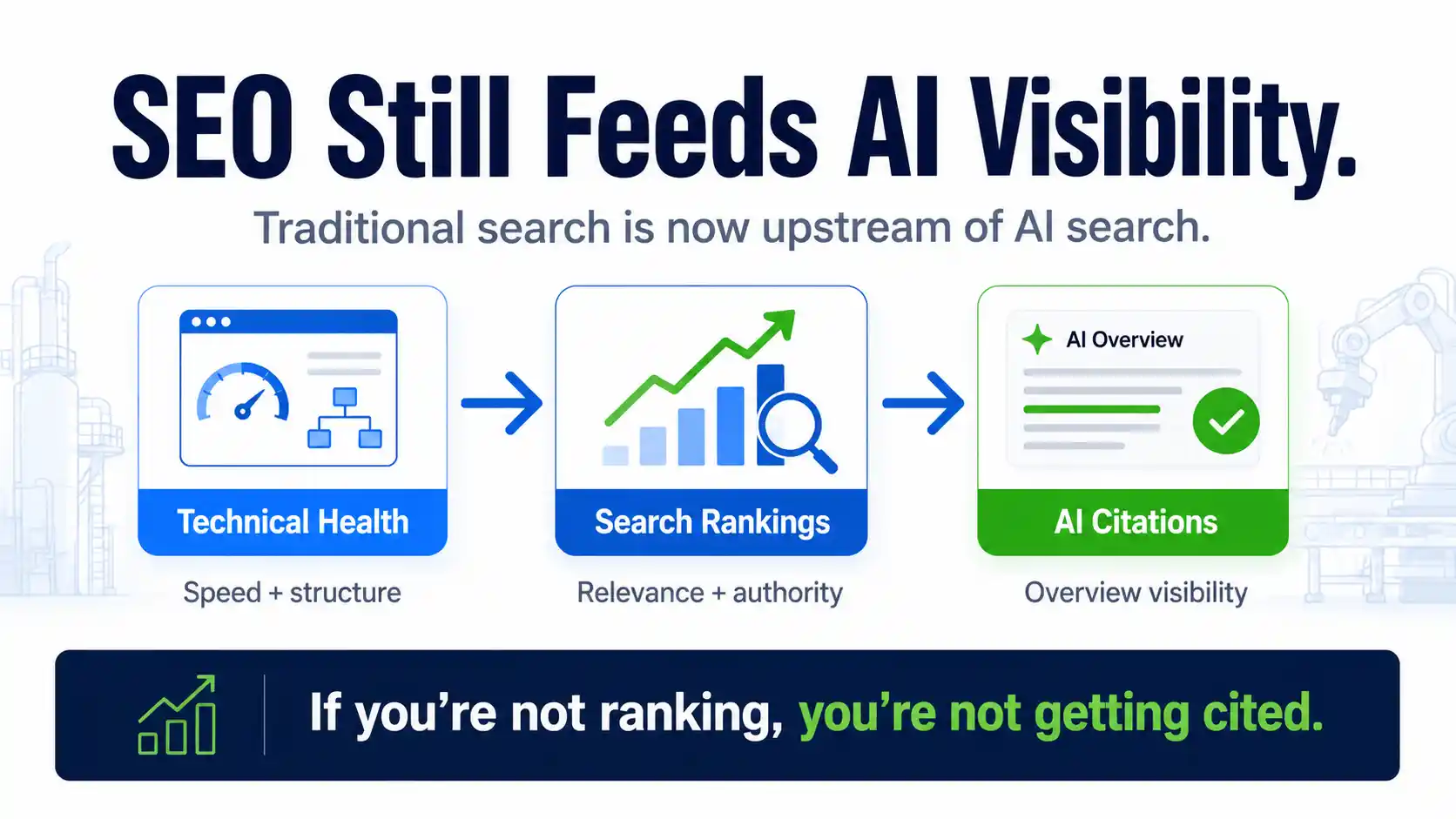
AI Overviews now appear on a growing share of those queries, but traditional ranking signals (technical health, on-page relevance, link authority) still determine which sources appear inside the AI Overview citations.
In other words: traditional SEO is now upstream of AI search, not parallel to it. A manufacturer that ranks well in traditional Google Search has a much higher probability of being cited in AI Overviews. A manufacturer with poor technical health and weak content does not show up in either.
The economic argument has moved from 'SEO vs. GEO' to 'SEO is the foundation AI sits on top of.'
What traditional SEO can still do for a mid-market manufacturer
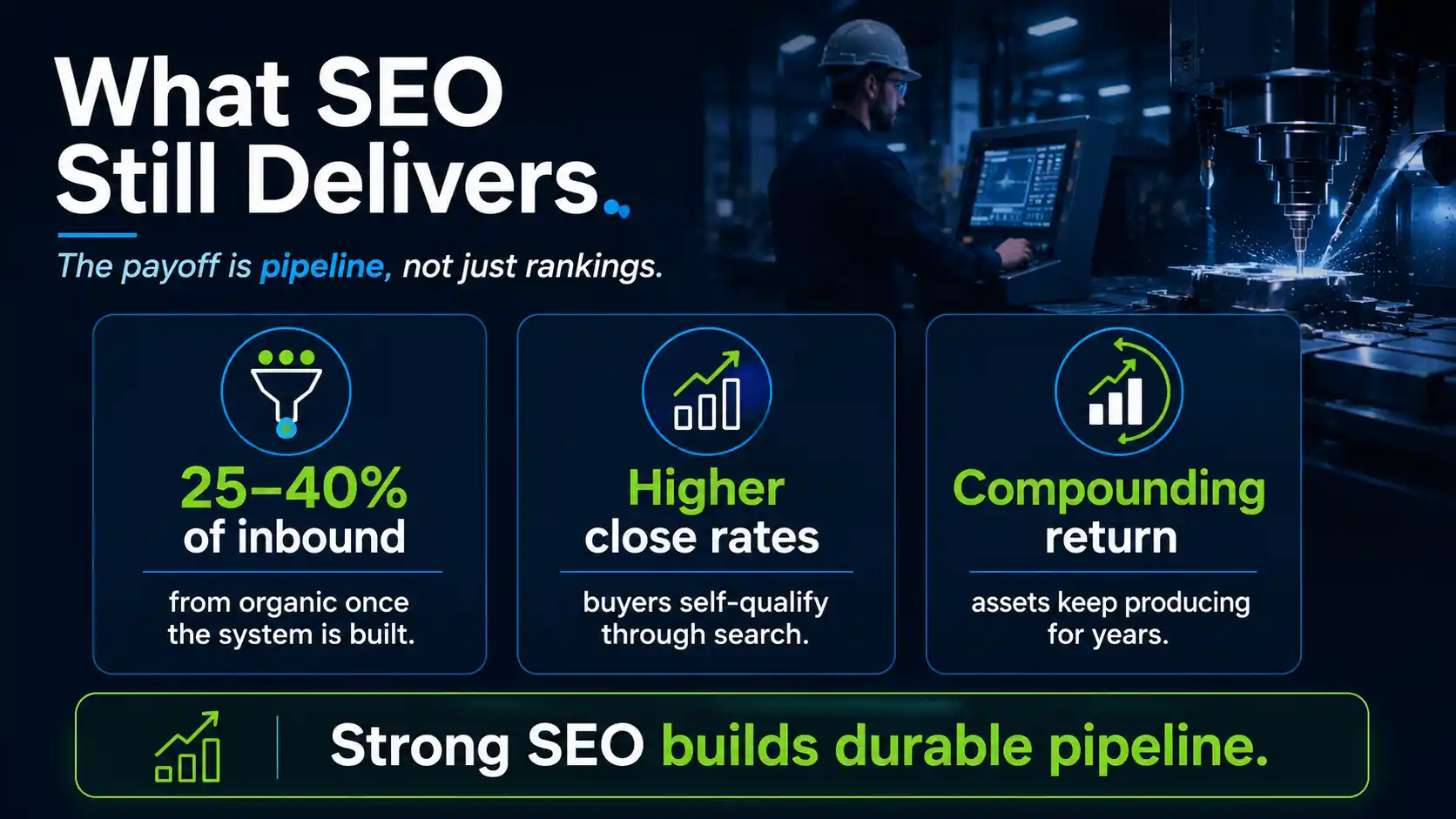
Three concrete outcomes show up consistently in manufacturer accounts that run SEO well. First, organic becomes a meaningful share of total inbound qualified leads at marginal incremental cost once the system is built. Second, organic-sourced deals tend to close at higher rates and faster cycles than paid-sourced deals because the buyer self-qualified through specific search behavior.
Third, organic compounds: the same content asset earning citations and rankings for three years produces sustained return over time.
Hot Shot Ovens ran the SEO playbook in this hub alongside its paid media and built a pipeline mix that did not collapse when one channel had a bad month. American Rotary built a similar dual-engine in the three-phase power market. The pattern repeats across mid-market manufacturers who commit to the process.
Precision Quincy and American Rotary sell into different rooms. One runs a classic industrial marketing strategy aimed at plant engineers and procurement committees. The other moves product through dealers and direct buyers in the same quarter.
The SEO mechanics barely change between them. What changes is which queries you chase and who is on the other end of them. Most manufacturers we work with are running two or three of those motions at once, which is the part a one-channel freelancer misses and a large agency bills you to relearn.
The 2026 operator framework
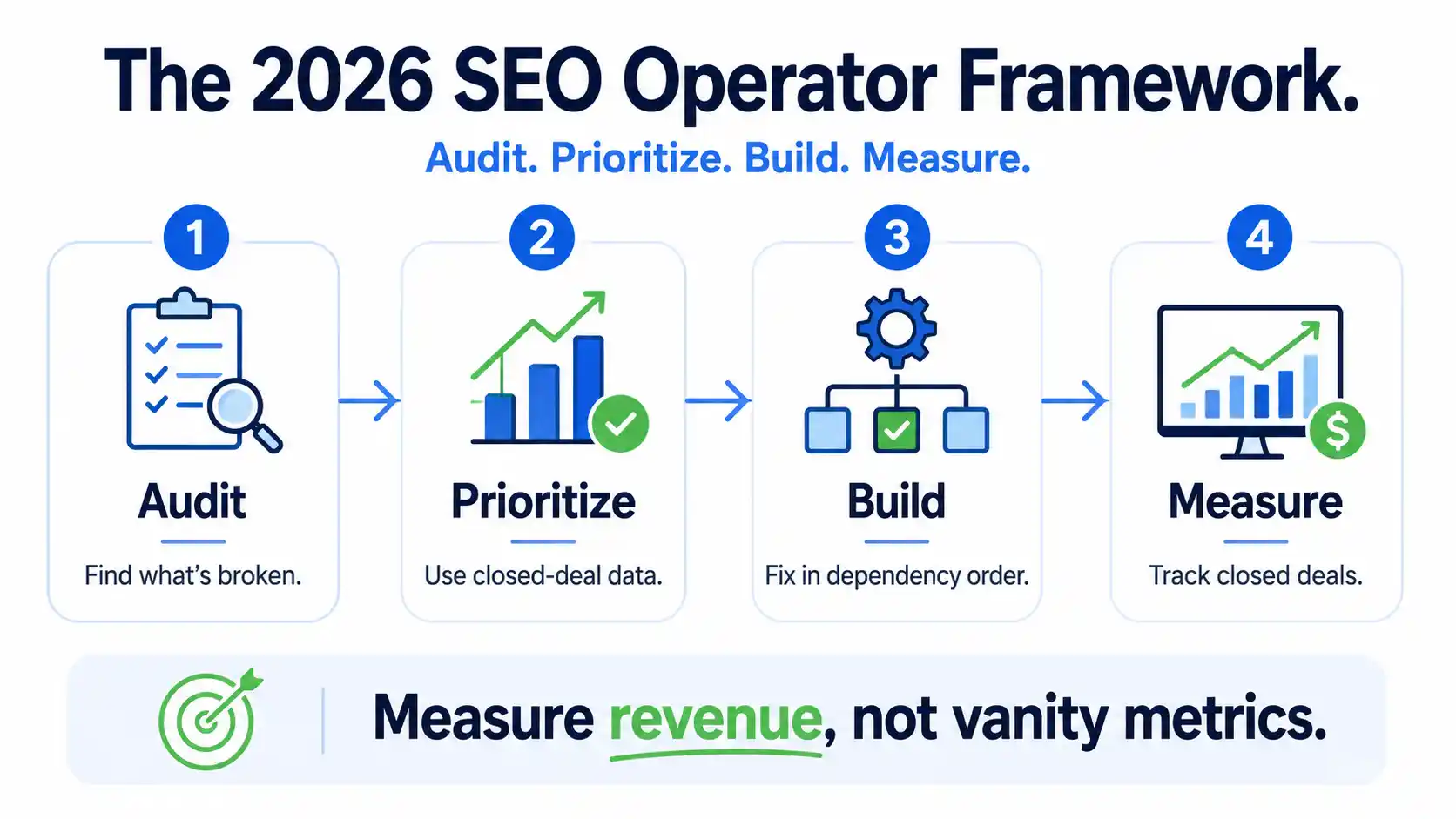
The Peak 10 SEO framework moves through four phases, mirroring the Modular Marketing System approach to all in marketing functions: audit, prioritize, build, measure.
Phase 1: Audit (weeks 1-12)
A real SEO audit covers all six components. The deliverable is a ranked list of 10 to 15 fixes, prioritized by impact-over-effort, plus a 12-month roadmap. Most manufacturer audits surface obvious wins (broken redirects, missing schema, slow mobile) that can produce meaningful organic-traffic gains inside the first 90 days.
Phase 2: Prioritize (week 13)
Not every fix is worth doing. Prioritize by closed-deal-data, not search-volume guesses. Fix the technical issues blocking high-intent product pages first, before chasing broader keyword themes.
Phase 3: Build (months 4-9)
Execute the roadmap in dependency order: technical first, on-page next, content gaps third, link earning continuously. Internal linking ties every new asset back into the hub-and-spoke architecture this cluster demonstrates.
Phase 4: Measure (continuous)
Track organic-sourced closed deals, not just rankings or traffic. Closed-deal data is the only metric that survives algorithm changes.
Where this hub goes next
Each of the six components has a dedicated supporting post in this cluster:
- Manufacturer keyword research (the one that finds your white space)
- Technical SEO for manufacturers (the foundation)
- On-page SEO for manufacturer product pages
- Schema markup for manufacturer SEO
- Local SEO for multi-location and dealer-network manufacturers
- Backlink building for B2B manufacturers
- SEO audit framework: a 90-day plan
Together these eight posts form the complete operator-grade SEO system for a mid-market manufacturer in 2026.
Frequently asked questions
Is SEO still worth the investment with AI search rising?
Yes, and arguably more than before. Traditional SEO signals now feed AI Overviews. A manufacturer with weak technical and content foundations does not appear in either Google or ChatGPT.
SEO is no longer a standalone channel, it is the substrate that organic visibility runs on.
How long until SEO produces measurable closed-deal revenue?
First measurable lifts (organic traffic, ranking improvements) typically appear 60-90 days into the work. Closed-deal revenue from new organic placements typically appears 4-9 months in, depending on sales cycle length. For high-ticket manufacturers with 60-120 day cycles, the first organic-sourced closed deals show up around month 6-9.
How does this work fit with paid media?
SEO and paid media are complementary, not substitutes. Paid media produces near-term pipeline at known cost. Organic produces compounding pipeline at decreasing marginal cost.
The strongest manufacturer marketing systems we have measured run both, with paid as the predictable engine and organic as the long-term compounding asset.
Where does SEO fit in a manufacturer's overall digital marketing plan?
SEO is one channel, not the whole plan. It is the piece that compounds, the asset that keeps pulling in buyers long after you build it, while paid search buys the demand that is ready today and email works the buyers who are not ready yet. On its own it is slow.
Run as part of a system, feeding the same CRM and measured against the same closed deals as everything else, it becomes the lowest-cost pipeline you have. For the full channel-by-channel picture and where SEO sits inside it, see our guide to digital marketing for manufacturers.
The rule holds across every channel: tie it back to revenue, or you are guessing.
Does this playbook only apply to industrial manufacturers?
No. The six components are the same whether you sell components into plants, move product through a dealer network, or ship direct to a consumer buyer. If your buyer is a plant engineer comparing specs, you are running an industrial marketing strategy and the queries skew technical.
If your buyer is a hobbyist with a credit card, the queries skew practical and the proof has to look different. Most manufacturers we work with run two or three of those at once. The system does not change.
The keyword set and the evidence you show do.

Related Resources
Learn More About the Future of Digital Marketing
The future belongs to those who build it. Discover how to engineer marketing systems that perform as precisely as your production line.