On-Page SEO for Manufacturer Product Pages: The Playbook

On-page SEO for manufacturer product pages is the work that pays best, because it targets your highest-intent, highest-revenue pages: the product, application, and category pages where buyers stand closest to a purchase. For most manufacturers, these money pages are also the most neglected assets on the entire site.
Where to focus first:
- The pages that matter: product, application, category
- Closest to the buying decision, by far
- Usually the most under-optimized real estate you own
The pattern is consistent across the manufacturers we have audited. For the broader system, see the SEO for Manufacturers hub.
We handle this for clients through our SEO services for manufacturers.
Why product pages get neglected
Most manufacturer marketing teams spend their content time on blog posts, application pages, and gated PDFs. Product pages get the spec sheet, a couple of images, and a request-a-quote button, then they get ignored. The ignored pages are usually the highest-revenue assets on the site because the buyers landing on them are closest to a purchase decision.
The opportunity is large and consistent: optimizing the top 10 product pages on a manufacturer's site usually lifts organic-sourced quote volume 30-50% within 90 days, with no traffic increase, just better conversion of the existing traffic.
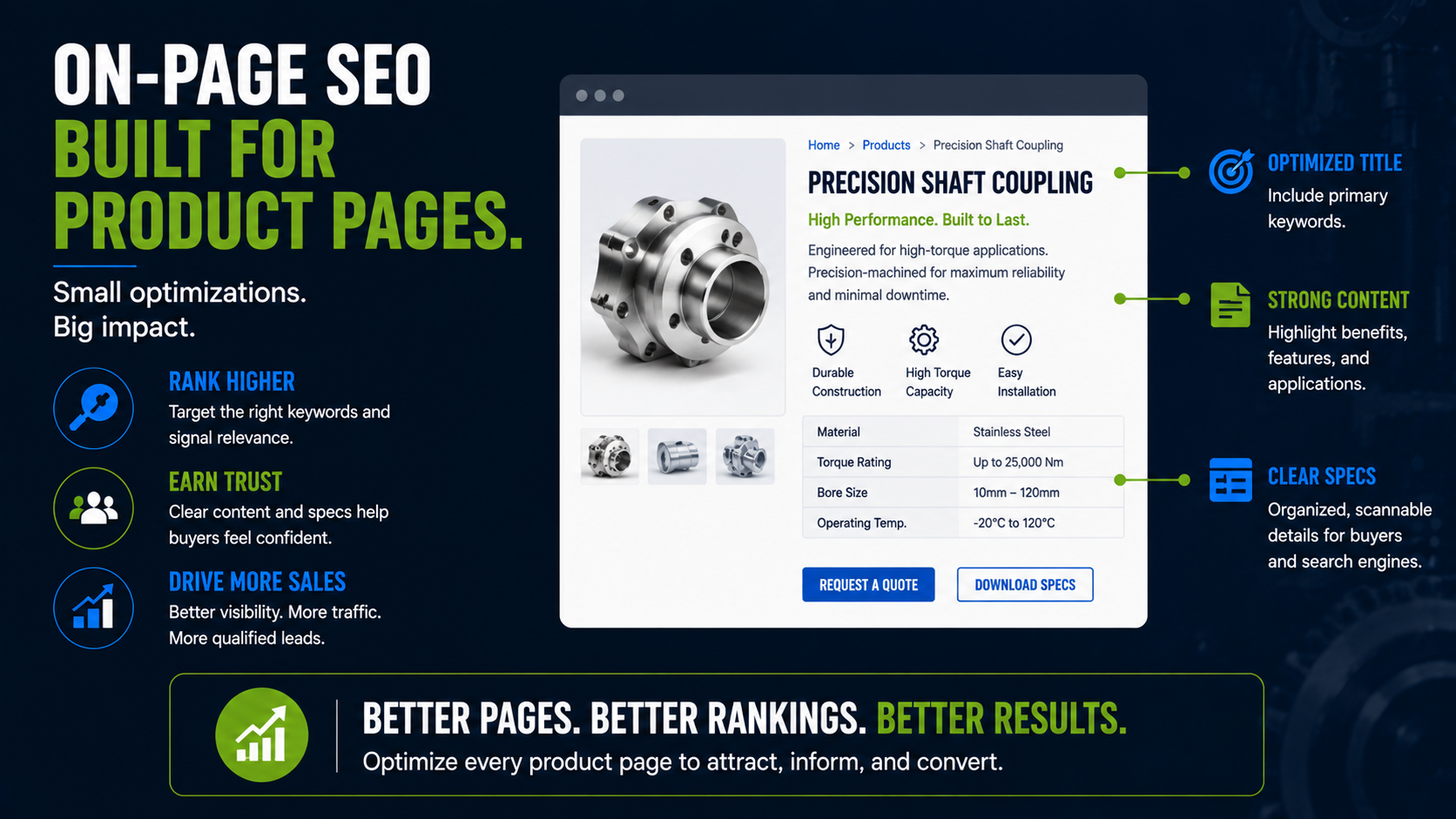
Title tag formula for manufacturer product pages
The title tag is the single most important on-page element for ranking. The right structure for a manufacturer product page is: [Product/Spec] [Use Case or Application] | [Brand]. Examples: '50 Amp Phase Converter for CNC Machines | American Rotary,' 'Cool-to-Touch Heat Treat Oven for Aerospace Alloys | Hot Shot Oven & Kiln,' 'Industrial Powder Coating Oven for Job Shops | Precision Quincy.'
Length matters: aim for 50-60 characters. Google truncates above 60. The primary keyword should appear in the first half of the tag because both Google and AI Overviews weigh earlier words more.
Heading hierarchy: H1, H2, H3
The H1 is the on-page headline and should match buyer language closely. Use one H1 per page. The H2 hierarchy structures the content for both Google and AI Overviews and should follow a buyer-question logic: What is it, who is it for, what does it do, what does it cost, what comes next.
A typical product page H2 sequence: 'What is the [product]?' / 'Who needs the [product]?' / 'Specifications and capabilities' / 'Applications' / 'Pricing and lead time' / 'How [Brand] differs from alternatives.' This sequence covers every major buyer question and gives Google a clean structural map of the page.
Body content: spec, application, proof
The body content of a manufacturer product page should follow a three-part operator structure: spec, application, proof.
Spec
Concrete numbers, dimensions, capabilities, certifications. The information a competing engineer needs to evaluate fit. Use a clean spec table, not a paragraph.
Spec tables get crawled cleanly and surface in AI Overview answers.
Application
What the product does in real-world manufacturer environments. Use specific use cases ('powder coating aerospace composites,' 'heat treating tool steels at 2000°F') instead of generic claims ('versatile applications').
Proof
Customer references, case studies, certifications, third-party tests. Proof is the difference between a product page that converts and one that gets bookmarked for later. Precision Quincy and American Rotary both lead with named-customer proof on their highest-converting pages.
Internal linking from product pages
Every product page should link out to: the parent category page, two or three sibling products, the relevant application pages, and the deepest blog content explaining the buyer's question. Internal links pass ranking authority and signal Google about the topical structure of the site.
Manufacturer product pages most commonly fail by being terminal nodes: a buyer lands, reads, and either converts or leaves. Adding 4-7 contextual internal links per product page typically lifts both organic ranking and on-site dwell time, both of which feed back into ranking authority.
Image SEO and alt text
Every image on a manufacturer product page needs three SEO elements: a descriptive filename ('industrial-powder-coating-oven-32ft.jpg' not 'IMG_8473.jpg'), descriptive alt text matching the image content, and modern compression (WebP, lazy-loading).
Alt text is both an accessibility requirement and a ranking factor. Manufacturer images surface in Google Image search at meaningful volume, especially for spec-specific queries. Hot Shot Oven & Kiln earns a measurable share of inbound from Google Image search by tagging product images with the cool-to-touch positioning.
Conversion paths on product pages
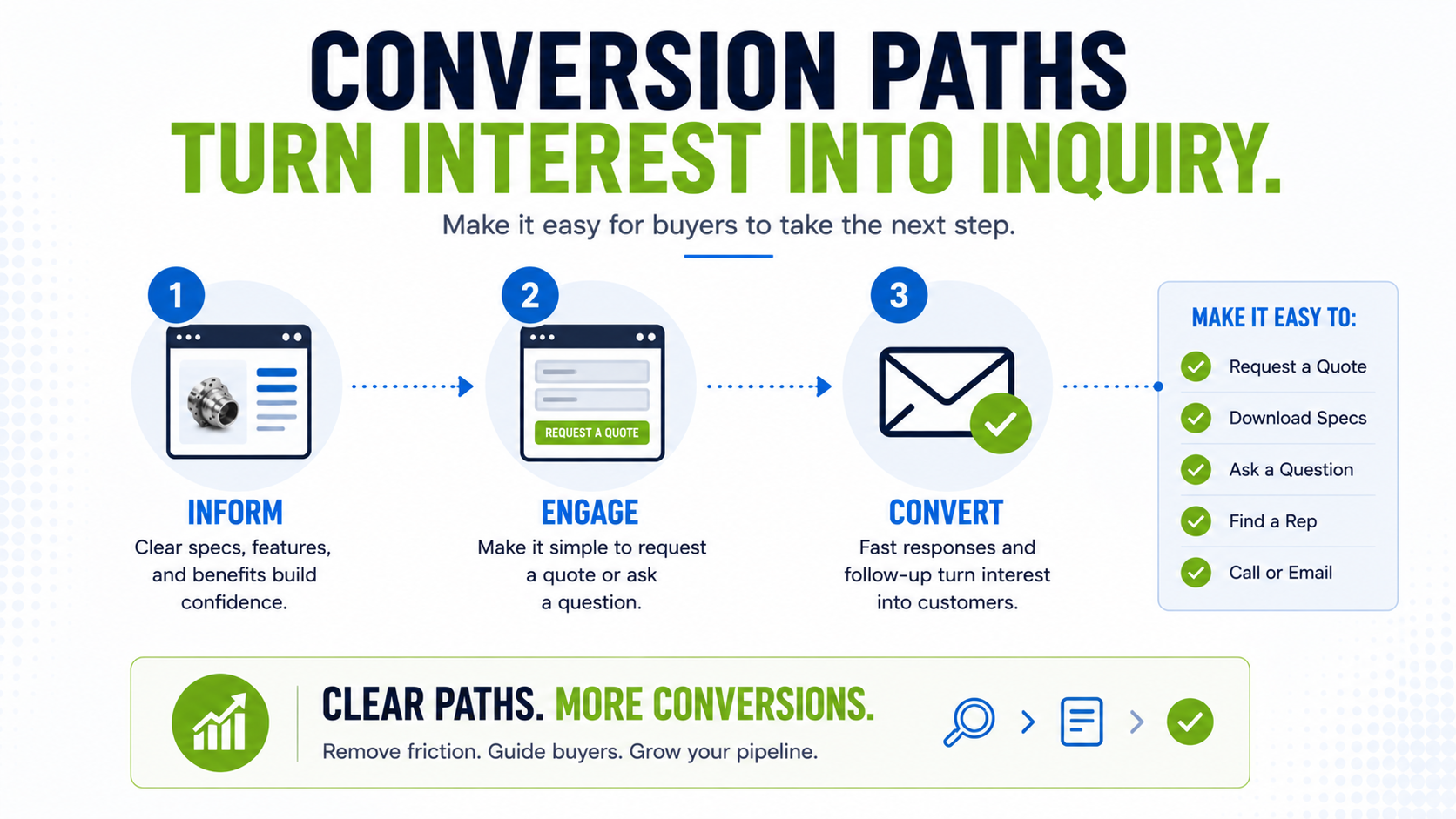
On-page SEO and conversion are linked. A page that ranks well but does not convert wastes the ranking. The conversion path on a product page should be three elements: a primary CTA (request a quote, schedule a consultation), a secondary CTA (download a spec sheet, see an application example), and a tertiary CTA (compare against alternatives, see related products).
The primary CTA should appear above the fold and again at the bottom of the page. Most manufacturer product pages bury the CTA below the spec table, which costs measurable conversion. The fix takes minutes.
Frequently asked questions

How long should a manufacturer product page be?
Long enough to fully answer the buyer's question, no longer. Most high-converting manufacturer product pages run 800-1500 words including spec tables. Pages under 400 words rarely rank for competitive queries because they lack topical depth.
Pages over 2500 words usually have padding that hurts conversion.
Should every product have its own page?
Generally yes for manufacturers with distinct product lines. Combining related products into a single page only works when the products are genuinely interchangeable. Buyers searching for a specific product expect to land on a page about that specific product.
How often should product pages be updated?
Refresh product pages when specs change, new applications emerge, or new customer references become available. At minimum, audit every product page once a year. Google rewards content freshness, especially on competitive product queries.

Related Resources
Learn More About the Future of Digital Marketing
The future belongs to those who build it. Discover how to engineer marketing systems that perform as precisely as your production line.