Why Most AI Content Is Invisible to Manufacturer Buyers (and the Fix)

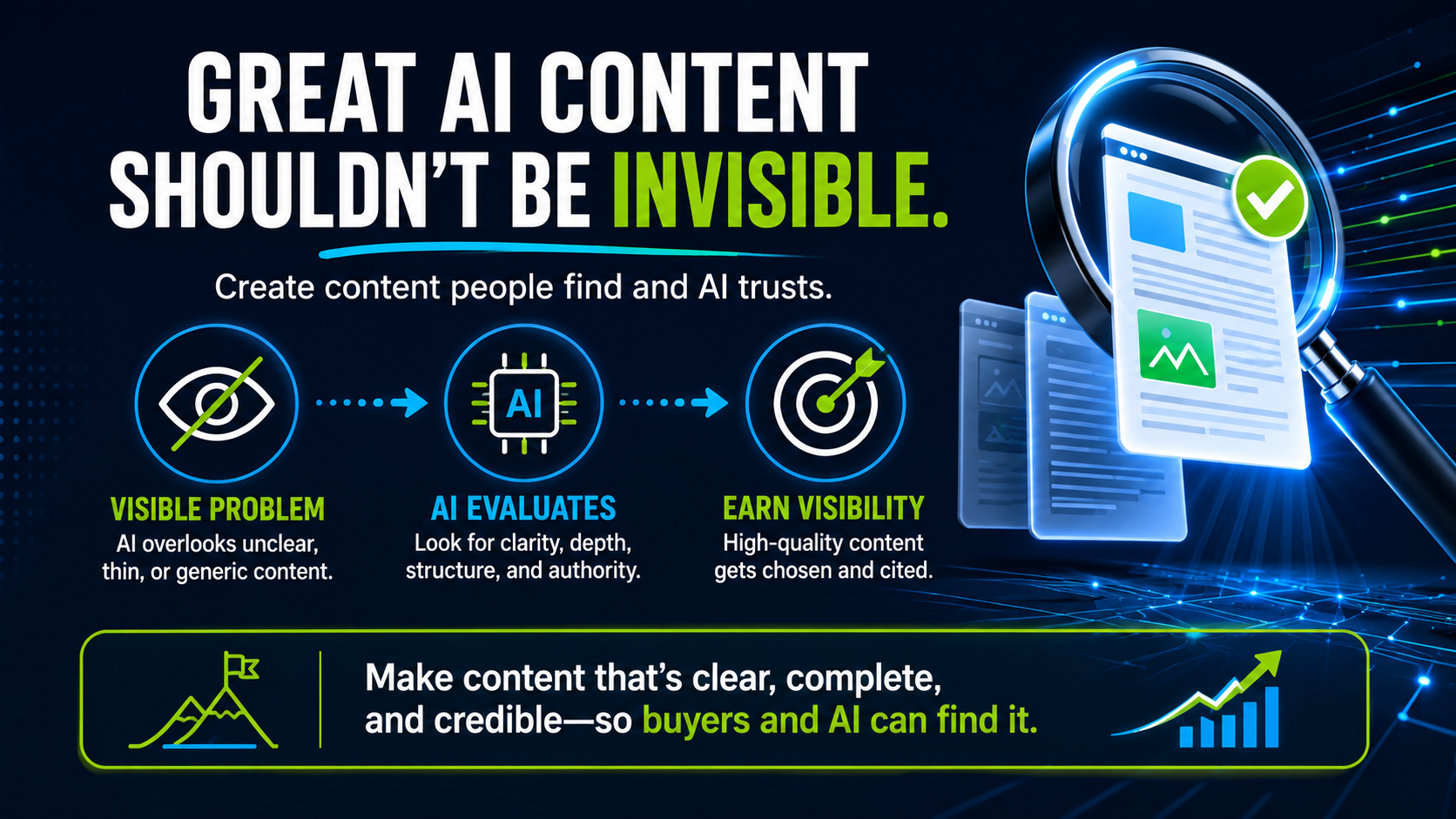
Most AI content for manufacturers fails for one reason: it's built wide and shallow. AI engines crawl nearly everything but cite only sources that prove deep authority on a specific buyer question. Large AI-generated content farms can draw heavy crawler traffic yet earn zero citations.
Quality trumps quantitty every day of the week.
The gap that decides everything:
- Crawled is not cited, that's the whole problem
- Engines reward depth on one buyer question
- Wide, generic, mass-produced content gets ignored
For the broader system this fits into, see the AI search visibility for manufacturers hub.
There Is a Big Difference Between Getting Read and Getting Recommended
Think about how a librarian works. She reads thousands of books. When a patron walks in and asks a question, she does not hand over every book she has read.
She recommends the two or three that best answer that specific question.
AI works the same way. ChatGPT, Perplexity, and Google's AI Overviews crawl massive amounts of content. But when a buyer types in a question, the AI does not surface everything it has read.
It surfaces the sources that best answer that specific question with authority and depth.
The technical term for this is a citation. A citation is when the AI names your company and links to your site as part of the answer. That is what drives awareness, traffic, and leads.
Random AI-generated content does not earn citations. Topic authority does.
What Manufacturers Are Getting Wrong Right Now
Many manufacturers have started using AI to generate content, which is not inherently a problem. The problem is the strategy behind it.
When content is created one piece at a time with no connecting thread, no targeted buyer question, and no industry-specific depth, it looks to an AI the same way it looked in that experiment: wide but shallow. AI systems are built to find the deepest, most authoritative answer available. Shallow content loses that competition every time.
This is also why niche marketing consistently outperforms mass marketing for manufacturers. Broad content aimed at everyone ends up resonating with no one, including the AI tools your buyers are using to find vendors.
The result is content that costs time and money to produce, gets crawled by AI bots building their training data, and never surfaces when the buyers you actually want are searching for solutions.
What Actually Earns AI Recommendations
The manufacturers who are winning in AI search share one thing in common: they own a topic.
That means building a cluster of tightly related content that answers every major question a buyer in their niche is likely to ask, from high-level industry problems down to specific product comparisons, application questions, and buying criteria.
When a buyer types "best industrial curing oven for aerospace composites" into ChatGPT, the AI looks for the source that has answered that question and the 15 surrounding questions better than anyone else. A company with a well-built topic cluster around industrial thermal processing owns that answer. A company with scattered AI content does not.
This is the foundation of the Peak 10 Target Market Domination System. Every piece of content has a job tied directly to a buyer question in your niche. Nothing is created for its own sake.
It is also what separates manufacturers who become recognized thought leaders in their category from those who just publish content. AI systems recognize and reward expertise that is demonstrated consistently over time, not sporadically.
Three Questions to Ask About Your Content Right Now
If you are currently producing AI-generated content without a structured strategy behind it, ask yourself these three questions:
1. Is each piece of content tied to a specific question your ideal buyer is actually asking?
If not, the content has no target and no way to earn a recommendation.
2. Does your content go deep enough on a topic to be the best available answer?
AI systems compare all available answers. Thin content always loses to authoritative content.
3. Are your pieces connected, or are they isolated?
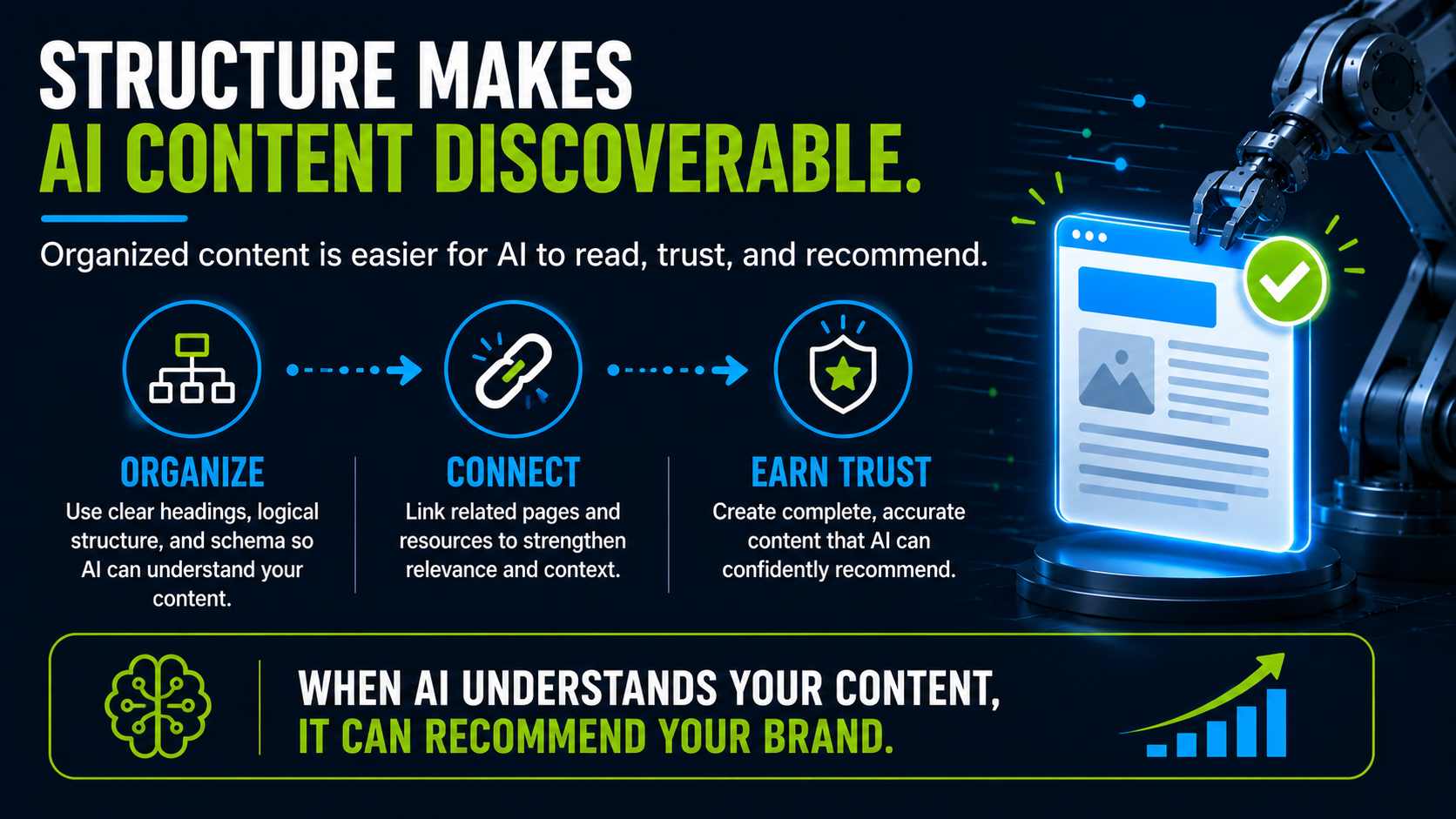
Isolated content signals a generalist. Clusters signal authority. AI rewards authority.
How the Modular Marketing System Solves This
Peak 10's Modular Marketing System treats content the same way a great manufacturer treats production: nothing goes out the door without a purpose, a process, and a measurable output.
The content component is built around topic clusters tied directly to buyer intent in your specific market. We identify the questions your ideal buyers are asking at every stage of their decision process, build a content architecture around those questions, and create pieces that connect and reinforce each other.
The result is a brand that AI systems recognize as the authority in your niche, which is exactly what the AI Readiness Roadmap for manufacturers is built to achieve.
The Bottom Line
Producing content is not the same as building a content strategy. Volume is not a substitute for relevance. And getting crawled by an AI bot is not the same as getting recommended to your next customer.
This matters now because the investment wave is already here. 95% of manufacturers are investing in AI in some form (Rockwell, 2025), and most of that spend goes into producing more content, not better-structured authority. The same discipline that wins citations also compounds classic manufacturing SEO: one deep page that answers a real buyer question outranks fifty shallow ones in both indexes.
If you are a small or midsize manufacturer and you want to understand what a targeted content strategy built for AI visibility actually looks like in your niche, that is exactly what we do.
Start with a Growth Engineering Session. Thirty years of marketing insight applied to your specific situation in 30 minutes. No pitch.
No fluff. Just a clear picture of where your content strategy stands and what it would take to own your topic.
Schedule your Growth Engineering Session

Related Resources
Learn More About the Future of Digital Marketing
The future belongs to those who build it. Discover how to engineer marketing systems that perform as precisely as your production line.