Local SEO for Multi-Location Manufacturers and Dealer Networks

Local SEO for manufacturers is how Google decides whether a ready-to-buy prospect lands on your plant or a competitor's down the road. It's the deliberate work behind Business Profile listings, location pages, NAP consistency, schema, and reviews. For multi-location shops and dealer networks, it's the map that routes buyers to your door.
What it comes down to:
- The levers: Business Profile, location pages, NAP, reviews
- Built for: multiple plants and dealer networks
- The stakes: the buyer goes to you, or to whoever's closer
American Rotary, with a dealer network across the US, treats local SEO as a structural growth lever. For the broader system, see the SEO for Manufacturers hub.
If you want it done for you, see our manufacturing SEO services.
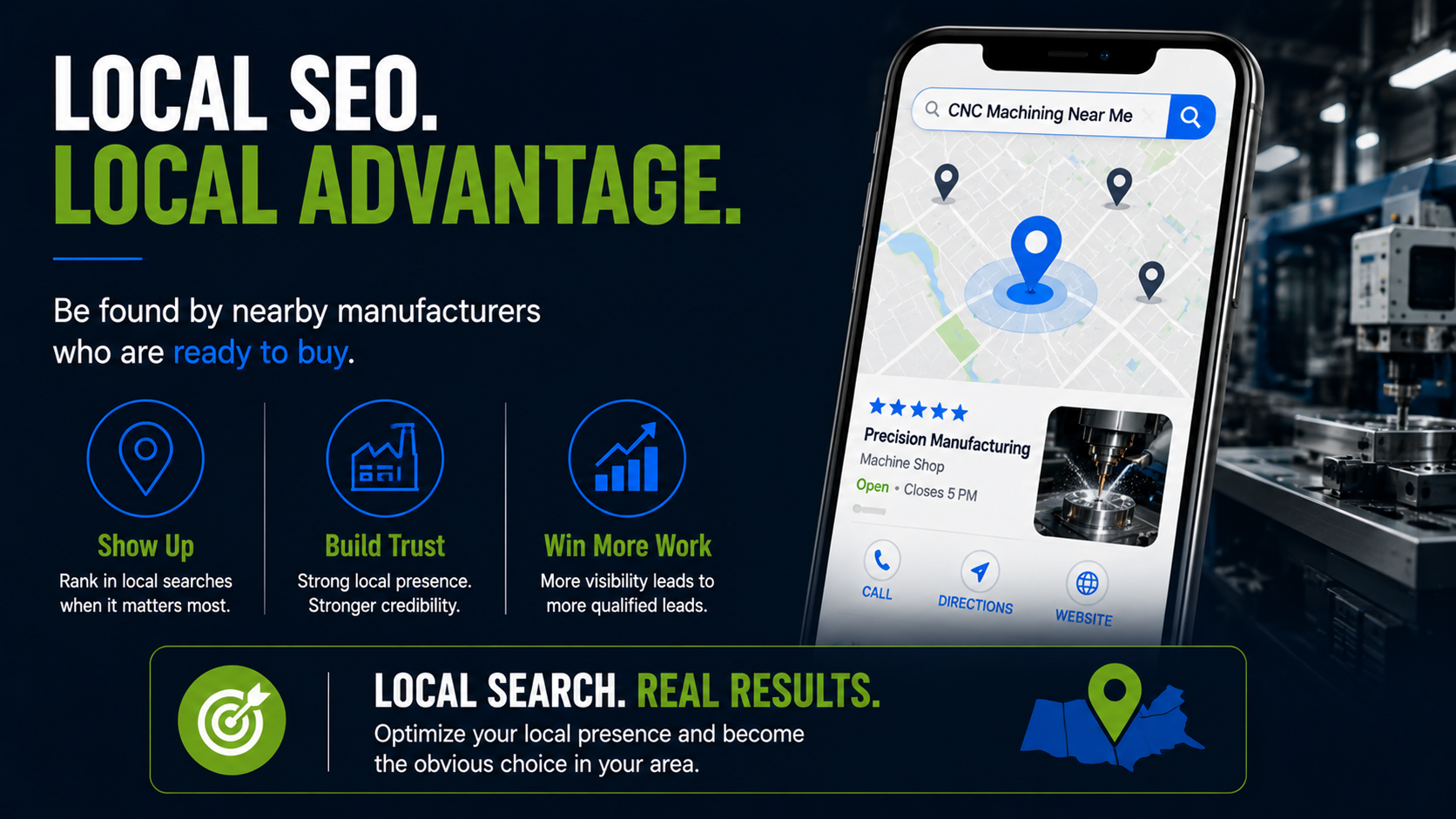
Who needs local SEO (and who does not)
Local SEO matters for manufacturers in three situations: (1) the manufacturer has multiple physical plant locations, (2) the manufacturer sells through a dealer network, (3) the manufacturer's buyers regularly search with geographic intent ('industrial oven manufacturer Texas,' 'phase converter dealer near me').
It does not meaningfully matter for single-location manufacturers selling nationally to a buyer base that does not search geographically. For those manufacturers, classic SEO investment is more leveraged. Most mid-market manufacturers fall into one of the three local-SEO-relevant cases.
Google Business Profile setup for manufacturers
Google Business Profile (formerly Google My Business) is the free Google product that lets a business control its appearance on Google Maps and in local search results. For each manufacturer location, claim the GBP listing, verify ownership, and complete every field: business name, address, phone, hours, website, services, products, photos, business description.
The fields most often left blank that materially impact ranking and click-through: services list, products list, business description, attribute tags, regular updates (Google Posts). Manufacturers who treat GBP as a one-time setup and forget it consistently underperform manufacturers who maintain it as a living profile.
Location-specific landing pages
Every plant location and major dealer location should have a dedicated page on the manufacturer's website, not a generic 'Locations' page with a list. The location page should include: full address with embedded Google Map, phone number, hours, location-specific photos, location-specific services or product lines, location-specific testimonials if available, and location-specific schema (LocalBusiness with geo coordinates).
Manufacturers with 5+ locations build these as a CMS template: each location is one item, populated with location-specific fields, rendered through a single template. Webflow handles this cleanly. The same approach works for dealer networks at scale.
NAP consistency and citation building
NAP stands for Name, Address, Phone. Local search rankings depend heavily on Google's confidence that the business's NAP information is consistent across the web. Inconsistencies (different spellings, old addresses, multiple phone formats) erode trust signals and depress rankings.
Audit NAP across: the website (every page footer), Google Business Profile, Bing Places, Apple Maps, industry directories (Thomas, IndustryNet), trade publications, supplier directories, and customer references. Fix inconsistencies. The audit is tedious; the ranking impact is consistent.
Local schema markup
LocalBusiness schema (or its industry-specific sub-types) on every location page tells Google explicitly: this is a real business at this physical location with these specific attributes. Required properties: name, address (with PostalAddress sub-type), telephone, openingHours, geo (with GeoCoordinates). Optional but valuable: image, priceRange, sameAs (linking to the GBP listing and other authoritative profiles).
Review acquisition and management
Reviews are a ranking factor and a conversion factor. Google's local algorithm weights review quantity, recency, rating, and content. For B2B manufacturers, customer reviews on Google Business Profile are harder to acquire than for consumer businesses, but they exist for every manufacturer with happy customers.
The acquisition pattern that works: ask the customer at the moment of clear satisfaction (after a successful installation, after a praising email), provide a direct link to the review form, and respond to every review (positive and negative) within 48 hours. Manufacturers who build a structured review process consistently outrank competitors with similar product offerings.
The dealer-network local SEO playbook
Manufacturers with dealer networks face a structural choice: control all local SEO centrally, delegate to dealers, or hybrid. Centralized control produces consistency but loads the manufacturer's marketing team. Delegated control produces variability and often underinvestment.
Hybrid is the model that works at scale.
The hybrid pattern: the manufacturer provides each dealer with a templated location page on the manufacturer's website (template-controlled), a templated GBP description (manufacturer-approved language), and a structured review-acquisition workflow (manufacturer-provided playbook). Dealers run the day-to-day. The manufacturer monitors NAP consistency centrally.
Frequently asked questions

How long does local SEO take to produce results?
Initial GBP optimization and location-page builds typically lift local visibility within 30-60 days. Sustained ranking improvement takes 6-12 months as review counts grow and citation consistency builds. Manufacturers tend to see results faster than consumer businesses because B2B local SEO is less competitive.
Does local SEO compete with classic SEO?
No, they complement. Classic SEO drives non-geographic queries; local SEO drives geographic ones. Some queries trigger both classic and local rankings (Google's local pack appears above organic for many local-intent terms), so a manufacturer winning both wins twice on the same query.
Should every dealer have a separate website?
Generally no. Separate dealer websites dilute the manufacturer's brand authority and complicate NAP consistency. Better practice: manufacturer-controlled location pages within the main website, with each dealer linked from a unified dealer locator.
The dealers can run their own social and email; the website hosts the local SEO.

Related Resources
Learn More About the Future of Digital Marketing
The future belongs to those who build it. Discover how to engineer marketing systems that perform as precisely as your production line.