Manufacturing Marketing: What It Is, How to Plan It, and How the System Works

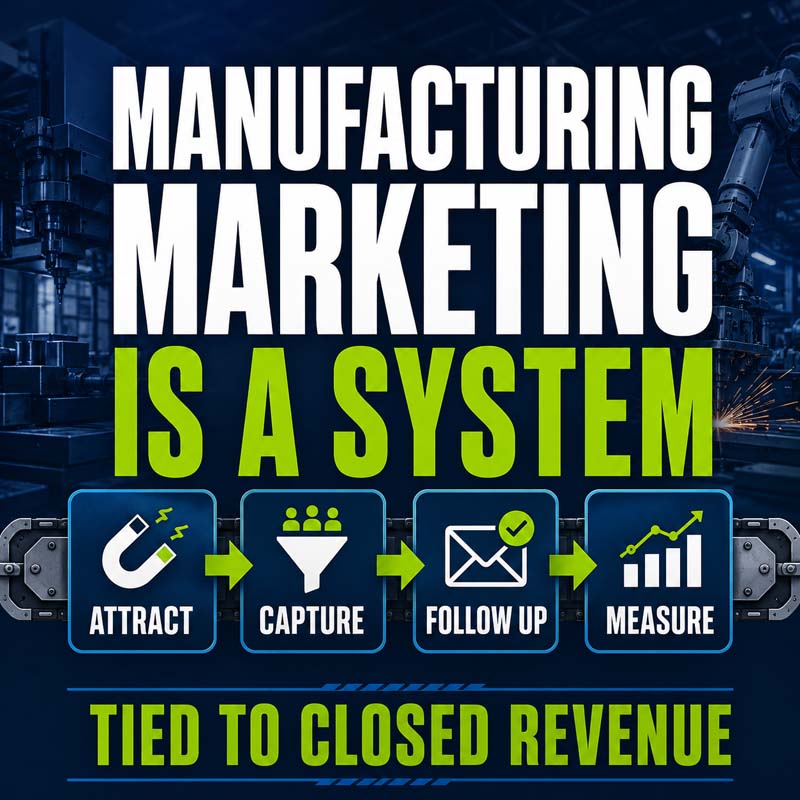
Manufacturing marketing is the discipline of generating predictable, measurable revenue for a manufacturer by connecting the right buyer to the right product at the right moment, and tying every dollar of spend back to a closed deal. It is not advertising, and it is not a website refresh. It is a system.
Manufacturers who treat it as a system produce pipeline they can forecast.
One manufacturer we work with, Precision Quincy, ran this kind of system to 54X return on ad spend in its first year. This guide explains what manufacturing marketing actually is, why it works differently than marketing for other industries, and how the pieces fit together.
What this guide covers:
- What manufacturing marketing is, and what it is not
- Why it works differently than consumer or general B2B marketing
- The system view: the parts and how they connect
- How to build the strategy: four levers and a 90-day rollout
- How to measure it so spend ties to revenue
Peak 10 is a manufacturing marketing agency that installs this system for mid-market manufacturers and measures it against closed deals.
What manufacturing marketing is
Manufacturing marketing is the full set of activities that move a technical or industrial product from unknown to bought: positioning, demand generation, content, search, paid media, lead capture, follow-up, and the measurement that connects all of it to the sale. The defining word is system. A manufacturer running five disconnected tactics has activity.
A manufacturer running those same tactics as one connected machine, each measured and tied to output, has manufacturing marketing.
What it is not: it is not being on every platform, it is not a logo and a brochure, and it is not lead volume for its own sake. A thousand cheap leads that never request a quote is not marketing, it is noise.
Why manufacturing marketing is different
Three structural facts set it apart from consumer marketing and even from typical B2B.
First, the market is thin at any moment. Only about 5% of your buyers are actively in-market this quarter (the 95-5 rule, per the Ehrenberg-Bass Institute), so a campaign judged only on this month's leads looks like it is failing when it is really just early. The other 95% are researching quietly, and the manufacturer whose content answers their questions is the one they call when they are ready.
Second, the buyer is technical and often a committee. A rotary phase converter, a heat treat oven, a tooling line: these are considered purchases with engineers, operators, and finance all weighing in. A single click rarely becomes a quote without a chain of touches in between.
But the committee is only half the picture.
Many manufacturers sell across a wide spectrum at once: an SME manufacturer's engineering team on one order, a small shop or a serious hobbyist with a credit card on the next. One client's product line has been bought by a global EV maker and by the small dental lab across town.
The committee deal runs on quotes over a six-month to one-year cycle. The small-shop order can close the same afternoon. Your marketing has to serve both buyers without treating either one as an afterthought.
Third, the sale usually closes offline. The purchase order lands over the phone, in an email, or through a distributor, so the ad platforms never see it. Left uncorrected, Google and Meta optimize toward whatever fills a form instead of whatever closes a deal.
The system: the parts and how they connect
Manufacturing marketing has a handful of parts. The mistake is running them as separate hobbies. The win is running them as one line.
Positioning and niche decide who you are the obvious choice for. Search and content capture the 95% while they research, which is where SEO for manufacturers does the compounding work. Paid search and social buy demand you can reach today.
Lead capture and follow-up turn interest into quotes, the focus of lead generation for manufacturers. And measurement ties the whole thing back to revenue. For the channel-by-channel build, see the digital marketing for manufacturers hub. The plan that sequences it is laid out below.
The connective tissue is the approach we call the Modular Marketing System: discrete modules, each measured, each tied to output, added one at a time instead of all at once.
How to build a manufacturing marketing strategy
The typical manufacturing marketing plan is a stack of tactics: run some ads, post on LinkedIn, redo the website, go to a trade show. None of them are wrong. But a pile of tactics with no system underneath produces random results, which is why quote flow feels unpredictable and the ad budget never seems to move the number.
Build it backward from the closed deal
An operator does not start a marketing strategy with channels. You start with the closed deal and work backward to the first click. That order is the whole difference.
Start with your best won deals. Pull the last 50 and find the pattern: the vertical, the application, the company size, the buyer title, the deal size. That pattern is your real target market, not the one on the About page.
Then define the argument that wins those deals. What did the won buyers believe about you that the lost ones did not? That belief is your core sales argument, and every piece of marketing exists to install it.
Only then do you choose channels, and you choose them by where those specific buyers actually are and how they buy, not by what is trendy. The sequence is target, message, channel, measurement. Reverse it and you get a busy plan that does not compound.
A strategy built this way works most often for mid-priced products, the couple-thousand to low-tens-of-thousands range that makes up the bulk of industrial sales, frequently sold online and at volume and measured on return on ad spend and average order value.
It also scales up to the smaller set of manufacturers selling high-end, engineered-to-order equipment that can run to a million dollars or more on a longer cycle. The strategy is the same system either way. What shifts is deal size, cycle length, and how many people sign off.
The four levers of a manufacturing marketing strategy
Peak 10 builds every manufacturer strategy on four levers, drawn from the Growth Engineering Manual. Run all four and the system compounds. Run one or two and it stalls.
- Engineer your core sales argument. Decide the single reason your best-fit buyer should choose you, and make every headline, ad, and page carry it. Precision Quincy did not win on "we make ovens." They won on a specific argument for a specific buyer.
- Install the modular marketing system. Build marketing as discrete, measurable modules, like a production line, so each part can be optimized, swapped, or scaled on its own. This is how American Rotary added tens of millions in new revenue without betting the company on one big campaign.
- Optimize your conversion infrastructure with M2CO. Connect marketing to the CRM and to closed-deal data so you can see which spend produced quotes and which quotes produced revenue. Most manufacturers are flying blind here, which is why they cannot tell what is working.
- Scale your closed-loop advertising and sales ecosystem. Once the loop from click to closed deal is measurable, feed the winners more budget and starve the losers. Growth stops being random and starts being a dial you turn.
A 90-day rollout you can actually run
You do not install all four levers at once. Add them on top of the marketing you already run, in phases, so you never disrupt current lead flow.
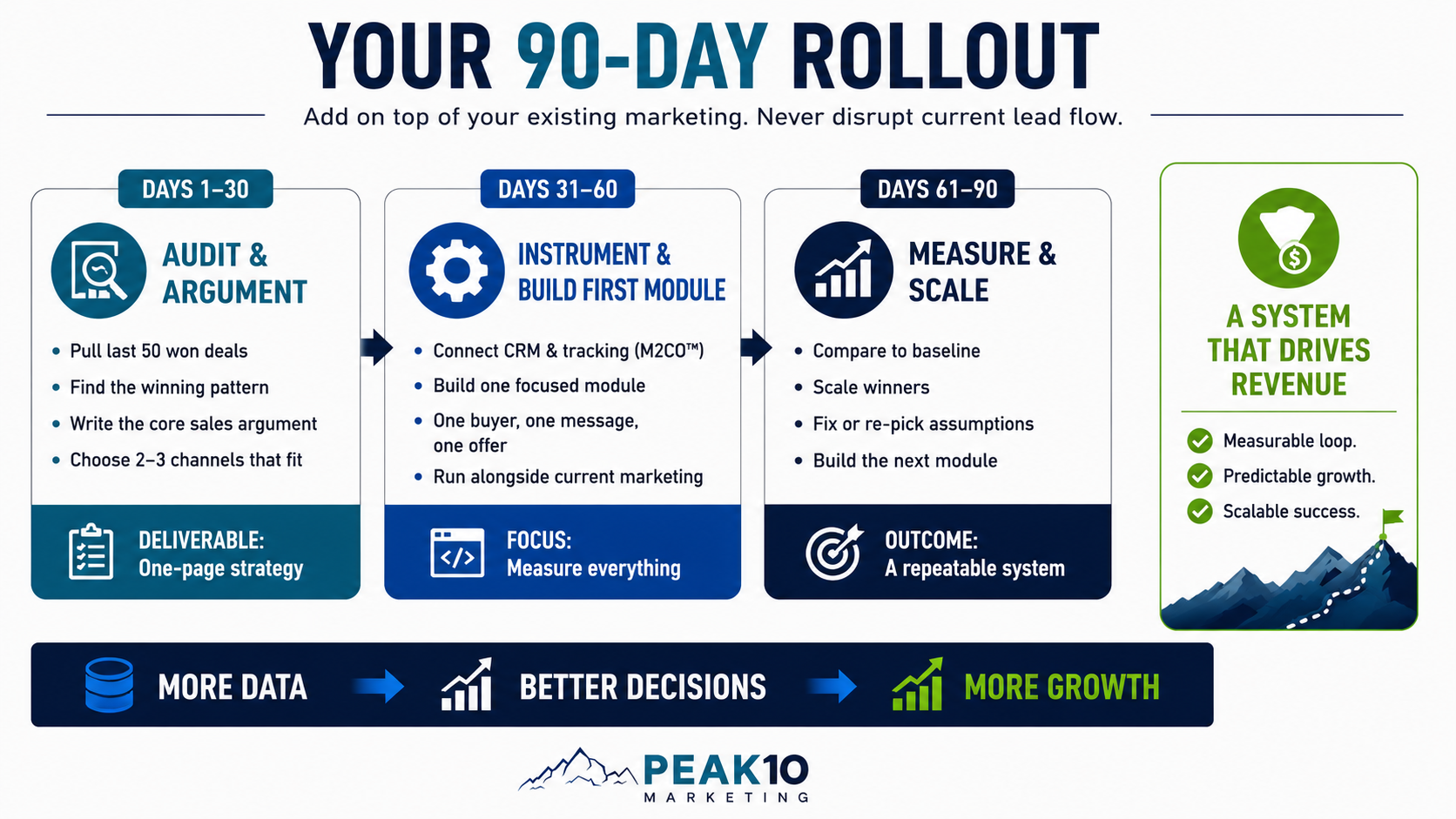
Days 1 to 30: audit and argument. Pull the closed-deal data, find the winning pattern, and write the core sales argument for that buyer. Deliverable: a one-page strategy that names the target, the argument, and the two or three channels that fit.
Days 31 to 60: instrument and build the first module. Connect the CRM and conversion tracking so you can measure. Stand up one focused module, one buyer, one message, one offer, and run it alongside everything else.
Days 61 to 90: measure and scale. Compare the focused module's cost per quote and close rate against your baseline. If it beats baseline, and a well-built one usually does by a wide margin, scale it and build the next module.
If it does not, the data tells you which assumption was wrong, and you re-pick.
At day 90 you no longer have a pile of tactics. You have a system with a measurable loop, and a repeatable way to add the next one.
How to measure manufacturing marketing
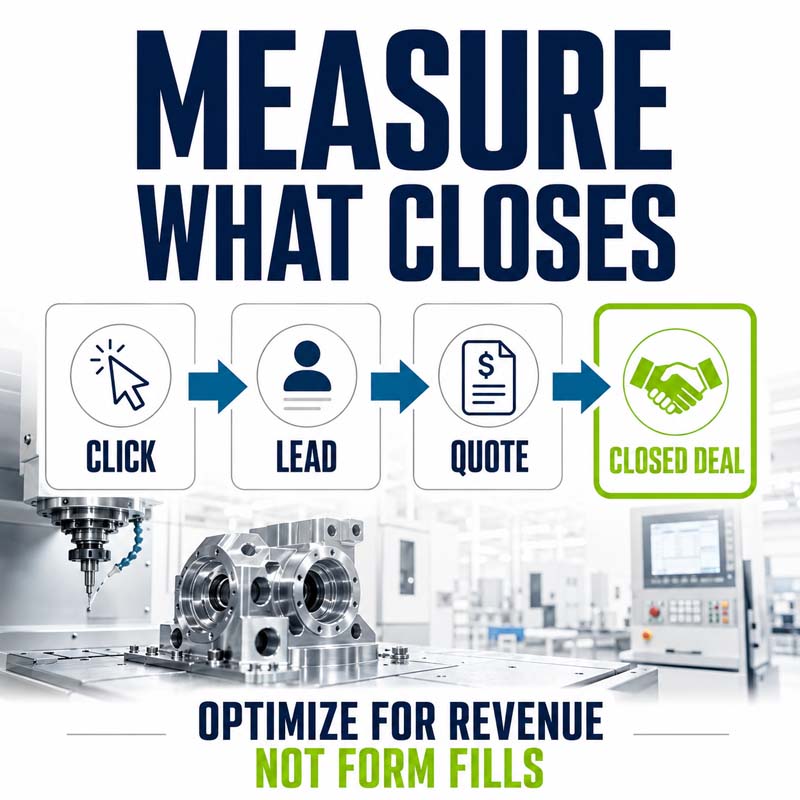
Measurement is what separates a marketing system from a pile of tactics. Because the sale closes offline, you have to feed your closed-deal data back to the ad platforms so they optimize toward revenue, not form fills.
This is the core of our M2CO method: track the buyer journey as milestones, click to lead to quote to close, and report on cost per quote and cost per closed deal rather than cost per lead. See how manufacturers connect offline sales to ad spend. Without this, every channel is a guess.
With it, marketing becomes a dial you can turn.
FAQ: manufacturing marketing
What is manufacturing marketing?
Manufacturing marketing is the system of positioning, demand generation, content, search, paid media, lead capture, follow-up, and measurement that turns a technical or industrial product into predictable, closed-deal revenue. Its defining feature is connecting every activity back to the sale.
How is manufacturing marketing different from B2B marketing?
It is not a separate discipline. Manufacturing marketing is B2B marketing, and often D2C and dealer marketing at the same time, because a manufacturer's customer mix can span every buyer type and company size. One client's product line has been bought by a global EV maker and by the small dental lab across town.
Another sells to worldwide car dealerships and to the local home-brew hobbyist. The Census math backs the mix: 98.3% of America's 239,265 manufacturing firms have fewer than 500 employees, and about three quarters have fewer than 20, so most manufacturer customers are small businesses themselves. What changes is not the fundamentals.
It is the tracking and the pages: big-ticket deals run on quotes and long sales cycles, direct orders close the same day, and your measurement has to see both.
Does manufacturing marketing work if we sell to both businesses and consumers?
Yes, and many manufacturers do exactly that. Buyers run from SME manufacturers to small shops to serious hobbyists. A plant engineer is comparing specs in the morning and a serious hobbyist or a small shop with a credit card shows up that afternoon.
You can judge both on return on ad spend, but the tracking is different. The business side is quote volume and close rate over a six-month to one-year sales cycle. The direct side is order value and return on ad spend this month.
Cut a channel because it looks weak without proper server-side tracking and you will usually be cutting a good one.
How do you build a marketing plan for a manufacturing company?
Build it backward from the closed deal. Start with your last 50 won deals to find the target-buyer pattern, define the argument that wins them, choose the channels where those buyers are, then instrument the loop so you can measure spend against revenue. Roll it out in 90-day phases on top of your existing marketing.
How long before a manufacturing marketing strategy produces results?
A focused module usually shows a better cost per quote and close rate than baseline within the first 90 days. Compounding organic and brand results build over 6 to 12 months. Manufacturers with longer sales cycles typically see the first strategy-sourced closed deals around month 4 to 6.
Where should a manufacturer start?
Start with measurement. Connect your CRM and conversion tracking so you can see which clicks become quotes, then turn on the one channel your buyer already uses before adding a second. Sequence beats spread.
If you want the parts mapped to your specific buyer and tied to your CRM, that is what the Growth Engineering Session is for. We review your last quarter of marketing and sales data and show you which activities are actually producing quotes. Schedule your complimentary Growth Engineering Session.

Related Resources
Learn More About the Future of Digital Marketing
The future belongs to those who build it. Discover how to engineer marketing systems that perform as precisely as your production line.