SEO Audit for Manufacturers: A 90-Day Framework

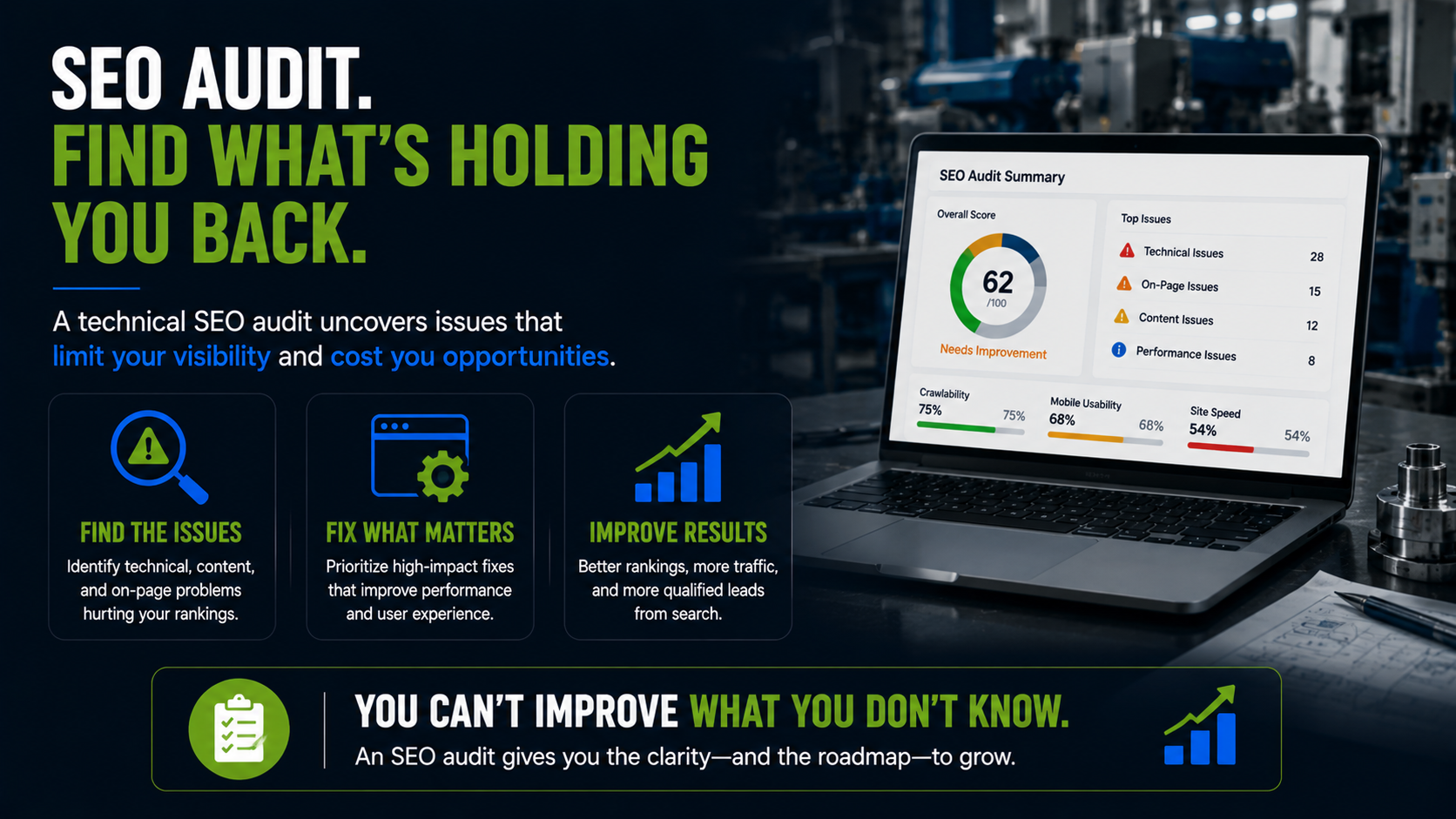
An SEO audit for manufacturers is a structured 90-day X-ray of your organic search: technical health, on-page optimization, content coverage, backlinks, and local presence. A real audit doesn't hand you a 200-item list. It hands you the 10 to 15 fixes that will move traffic and pipeline most over the next year.
What a real audit covers:
- The scope: technical, on-page, content, links, local
- The output: a ranked list of 10 to 15 high-impact fixes
- The horizon: 90-day audit, 12-month payoff
For the broader system this audit feeds, see the SEO for Manufacturers hub.
We handle this for clients through our SEO services for manufacturers.
What a real SEO audit covers
A complete SEO audit covers six phases. Each phase produces a specific deliverable: a scored health check, a list of issues, and a prioritized list of fixes. The output of all six phases together is a 12-month roadmap with ranked actions, expected impact, and required resources.
Most quick SEO audits skip phases or run them shallow. The result is a list of generic recommendations no one acts on. The framework below takes 12 weeks because each phase requires real data pulls, real spreadsheet work, and real prioritization.
Done well, the audit pays back the investment in months and compounds over years.
Phase 1: Technical audit (weeks 1-2)
The technical audit covers the 8 foundations from the technical SEO post in this cluster: page speed, mobile-first, crawlability, sitemap, internal links, HTTPS, schema, canonicals. Use Google Search Console, PageSpeed Insights, Screaming Frog, and a manual mobile review.
Deliverable: a green/amber/red score for each foundation, a list of specific URLs failing each, and an estimated dev effort to fix each category. Most audits surface 5-15 technical issues in this phase, ranked by ranking-impact-per-effort.
Phase 2: On-page audit (weeks 3-4)
The on-page audit covers the top 50 most-trafficked and most-revenue-relevant pages on the site. Score each page against the on-page playbook: title tag formula, heading hierarchy, body content structure (spec/application/proof), internal linking, image SEO, conversion paths.
Deliverable: a per-page scorecard, the 10-15 highest-impact rewrites identified, and an estimated content-team effort to execute each. On-page rewrites are usually the highest-ROI single SEO investment for mid-market manufacturers because the work is fast and the impact is measurable in 30-90 days.
Phase 3: Content audit (weeks 5-7)
The content audit goes broader than on-page. It maps the manufacturer's full content portfolio against the keyword universe: which buyer queries are covered, which are not, where coverage is shallow, where coverage is duplicated.
Deliverable: a content-gap matrix showing the high-value keywords without dedicated pages, a content-quality scorecard for existing pages, and a 12-month content roadmap with priorities. The content roadmap typically includes 8-15 new pieces and 10-20 rewrites of existing content.
Phase 4: Backlink audit (weeks 8-9)
The backlink audit pulls the current backlink profile from Ahrefs or SEMrush, scores each link source for quality and relevance, identifies any toxic links, and benchmarks against 3-5 close competitors.
Deliverable: a backlink quality score, a list of link sources to disavow if any, a competitor-gap list (links competitors have that you do not), and a 12-month link-earning plan based on the legitimate sources from the backlink-building post in this cluster.
Phase 5: Local audit (week 10)
The local audit covers Google Business Profile, location pages, NAP consistency, local schema, and review profile, for every location and dealer relevant to the manufacturer's local SEO footprint. Audit each location with the local SEO playbook from the local SEO post in this cluster.
Deliverable: a per-location scorecard, a NAP-consistency report, a review-acquisition gap analysis, and a 90-day plan to bring the lowest-scoring locations up to standard.
Phase 6: Prioritization and roadmap (weeks 11-12)
The final phase consolidates the 5 component audits into a single ranked roadmap. Each potential fix is scored on three dimensions: estimated organic-traffic-and-pipeline impact, estimated effort to execute, and dependency relationships (some fixes require others first).
Deliverable: a 12-month roadmap, broken into quarterly themes, with the top 10-15 actions identified by name. Each action has an owner, a deliverable, an expected impact, and a target completion date. The roadmap is the artifact that turns the audit into action.
The audit deliverables checklist
A complete audit produces these specific artifacts:
- Technical SEO scorecard (8 foundations, green/amber/red, with URLs).
- On-page scorecard for top 50 pages with per-page rewrite priority.
- Content gap matrix mapping keywords to existing or missing pages.
- Backlink profile assessment with disavow list (if any) and competitor gap.
- Local SEO scorecard for every location, with NAP and review status.
- 12-month prioritized roadmap with named actions and expected impact.
- Executive summary capturing the 5 highest-leverage fixes for the next 90 days.
Without the full deliverable set, the audit is incomplete. Manufacturers occasionally pay for 'quick' audits that produce only the executive summary; those audits typically do not survive contact with reality because the underlying scorecards are missing.
Frequently asked questions
How often should manufacturers run a full SEO audit?
Run a complete audit at the start of any structured SEO program (year zero), then a refresh annually. Run quarterly mini-audits focused on one or two phases (most often technical and content) to catch new issues. Most mid-market manufacturers we work with operate on this cadence.
Can a manufacturer run an SEO audit internally?
Some phases (technical with the right tools, local SEO, NAP consistency) are within reach of an in-house marketing team with SEO experience. Others (content gap analysis, backlink quality assessment, prioritization) benefit from outside expertise because the judgment calls require pattern matching across many manufacturer accounts.
What does a good SEO audit cost?
For a mid-market manufacturer, a complete external audit typically costs $5K-$15K depending on site size and complexity. The ROI is consistent: most audits produce roadmaps that lift organic-sourced pipeline by 30-100% over 12 months when executed. The audit cost is recovered inside the first 60-90 days of execution in most cases.

Related Resources
Learn More About the Future of Digital Marketing
The future belongs to those who build it. Discover how to engineer marketing systems that perform as precisely as your production line.